Showing posts with label Articles. Show all posts

Monday, June 02, 2014

Just then, she felt like ranting

This post has been percolating for a few weeks now. It started with a book I received from Goodreads. The paranormal premise intrigued me, so I was excited to receive a copy in the mail in April. The prologue set us up nicely and had me eagerly turning the pages. By page fifty, however, I had picked up on a nasty habit of the author’s that had me irritated and almost prevented me from finishing: the (excessive) use of “just then.” He used it in nearly every chapter, sometimes twice, and even five times in one chapter near the end. It annoyed me to no end, distracting me from what would have been an excellent book and forcing me to downgrade it in my review.

It bugged me so much it had me groaning when, not far into my next book — one by an author whose books/series I had come to enjoy — I encountered the dreaded “just then.” Inundated by them in the previous book, I now found myself oversensitive to them. Even the use of it once in a single novel grates on my nerves.

I finished a book two weeks ago in which another author showed her weak dependence on the use of “just then.” With a resigned sigh, I started the next book in the series. By chapter nine I was seriously irritated with the author, to whom I offer this advice: before you turn in your next book, use the "find" feature and delete every "just then" in the manuscript. All of them!

In nine chapters we saw it eleven times, five of which were in the second chapter alone — and three of those clumped together in one scene. Some might argue that it's her "style," but there's nothing stylish about it. It's weak, sloppy and lazy writing.

In every instance, the sentence would not only stand on its own without it, but would also be stronger. Better. We were not allowed to use this gimmick in my HS and college English/writing courses, which makes the fact that editors would allow it all the more astonishing.

Last weekend, I wanted a lighter, fun read for the long holiday so opted for one I've seen highly recommended by people online. Yes, you guessed it — the dreaded "just then" cropped up several times. And this is a RITA award winner for best first book! This was not my only problem with this book, but it was one of the biggest and — again — caused me to downgrade it.

It's been a relief this past week to find not a single "just then" in John Steinbeck's classic, East of Eden. This is a prime example of what writing should be, no matter what the genre. Writing is not about taking short cuts or using unnecessary filler words to make a word count. It's about clean writing and making every word count.

Apparently I am not alone in my opinion. A web search on the subject landed me on this post by author Bridget McKenna, who says “Adding unnecessary words before the action of a sentence begins slows it down, and your writing along with it.” How right she is!


Here are a few examples of what I am talking about, taken directly from four recent reads:


1. Just then we pulled up in front of my office, and for the first time I felt the full sting of the disastrous afternoon...

2. Just then, to my right, Sal jumped behind me...

3. My eye drifted to my purse just then, and I noticed the small notebook that I'd used when I'd written down the details of my dream..."

4. Just then I was overcome by a succession of coughs...
(It actually occurred twice in this particular paragraph.)

5. Just then, through the darkness of the room, I saw to my immense relief a large black trunk...

6. Just then there was a quick knock on my door and Cat and I both looked up...

7. Just then my cell phone chirped loudly from my purse...

8. Just then Dutch reached for the light switch...

9. Just then a door opened off the lobby...

10. Just then Adam knew something was amiss.

11. Just then he detected an elegant scent, just like a woman’s perfume, carried to him on the ocean breeze.

12. Just then a rare smile crossed her lips as she thought about the other part of last night.

13. Just then she realized that she had made her decision . . .

14. Just then he saw a professor he recognized . . .

15. Just then Garrett felt his consciousness slipping away again.

16. Just then the room shifted violently again, this time to a greater degree than before.

17. Just then Constance walked into the room.

18. Just then his stomach growled . . .

19. Just then they heard a door open and close.

20. Just then Sergeant D— walked up . . .

21. Just then I noticed a kid huddled under the steps of the school . . .

22. Just then NG walked by . . .

23. Just then, C— crashed into the apartment . . .


Get what I'm saying here? In every instance, the "just then" is superfluous — not to mention down right annoying and distracting. Do yourself and your readers a favor and avoid using these unnecessary filler words. Your writing will be cleaner and stronger. Not to mention the added bonus of not annoying readers.


Thursday, November 21, 2013

Thursday Thirteen 310: Make-A-Wish


This week's T13 was inspired by the most uplifting news story ever -- especially during a week of such devastating storms both across the USA and around the world.


Last Friday, the city of San Francisco transformed itself into Gotham for the day, to grant the wish of a little boy with leukemia who wanted to be Batman.

5-year-old Miles "Batkid" Scott’s wish was made possible through the Make-A-Wish Foundation, with the help of thousands of San Franciscan citizens who turned out to support and donate their time and money.

Make-A-Wish was started in 1980, when a US Customs Agents told a co-worker with the Arizona Department of Public Safety about a friend’s young son who had leukemia and wanted to be a police officer "to catch bad guys." Through interdepartmental help, they make Chris’s dream come true, days before he passes. (Read more here)

Those involved realize they don’t want the good feeling to end there, and in November of 1980 the group receives its tax-exempt status as a non-profit organization. By the following spring the group has raised $2000 and can grant its first official wish, which is for another little boy with leukemia.

In spring of 1982, the television show NBC Magazine does a story about this small new charity that’s granting wishes to children fighting for their lives. Phone lines are then jammed with calls from people who want to be part of it.

The national Make-A-Wish Foundation is based in Phoenix, Arizona and was incorporated in May of 1983. There are now 61 chapters across the US and its territories.

Make-A-Wish International, also based in Phoenix, is the hub for wish-granting activities in 48 countries, outside of the United States, on five continents. Visit World Wish for more info.

About 27,000 children are diagnosed with a life-threatening medical condition each year in the US.

Make-A-Wish granted 14,000 wishes last year, about one every 38 minutes. More than 226,000 children in the United States have benefited from having their heartfelt wishes granted since the foundation started.

Making a wish come true can change the outcome of a life-threatening disease, but also impacts all those involved. Just the act of making their wish come true can give the wish kid the courage to comply with their medical treatments, or make parents feel more optimistic, which in turn helps the child affected.

"According to the results of a 2011 Wish Impact Study that surveyed wish parents, health professionals, and volunteers, a wish come true empowers children with life-threatening medical conditions to fight harder against their illnesses." (Wish impact, Make-A-Wish website)

Make-A-Wish mission: We grant the wishes of children with life-threatening medical conditions to enrich the human experience with hope, strength and joy.

For a sixth year, Macy’s is teaming up with the Make-A-Wish for their Believe campaign. Starting in November, children can drop off their letters to Santa at any Macy’s department store. For each letter received through Dec. 24, Macy’s will donate $1 to Make-A-Wish, up to $1 million. "Yes, Virginia," presented by Macy’s, will air on CBS on National Believe Day, Friday, Dec. 6.


LINKING TO: Thursday Thirteen


Disclaimer: I am not associated in any way with Make-A-Wish or Macy's.


Wednesday, March 14, 2012

Thursday Thirteen 241: Get organized

I am a fairly well-organized person. This comes in part from my abhorrence of clutter, a penchant for liking everything in its place, and four years of college dorm life where I learned to economize space. Here are some ideas for organizing your home, taken from my own.


1. Closets are notorious for wasted space. For example, my linen closet. There is about three feet of empty space between the top shelf and ceiling. The solution? A storage module placed on the top shelf instantly adds more room for storage. If adding units to top of a longer shelf--such as that of a bedroom closet--make sure the shelf has proper support (use anchors if adding extra brackets), or it will sag and either make it impossible to move hangers, or tip everything onto the floor--or both.


2. Since my bathroom does not have a medicine cabinet, baskets help corral health and beauty items on one shelf of the linen closet, keeping shelves neat, and items easy to find. Decorative baskets can also be placed on bathroom vanities or back of the toilet, to hold soaps, lotions, etc., and I have one under the sink for cleaning products.


3. Shelving and storage modules come in a variety of colors, shapes, and sizes these days. Some companies sell mix-and-match units, such as the drawer and two-unit combos below. The only caveat here: be careful not to place too much weight on the drawer unit. Yup, learned that lesson the hard way. After repairing the drawer, I had to move it from bottom of the five-unit stack to the middle.


4. Other free-standing units are perfect for creating extra storage space in the bedroom, playroom, craft room, walk-in closet, garage--you get the picture. You can stack them for a tall corner unit, or line three or four up in a row at the end of a bed, or to divide a larger room in two, without making it look cluttered.


5. This set (two 3-shelf units stacked atop each other) adds space to the closet, and is perfect for sweaters, sweatpants and other items you might not want to hang. You can also buy wicker or fabric baskets to fit each shelf, if you want a classier "drawer" effect.


6. Storage bins are perfect for seasonal items such as Christmas decorations, or winter/summer clothing that is out of season. I highly recommend plastic storage containers over cardboard boxes for use in basement or garage space where leaks could occur. Depending on weight, they can be stacked three or four high--or slide them onto a sturdy, wide shelving unit.


7. Corral wrapping paper and trimmings with a hanging organizer (pictured), a standing module, or under-the-bed model. Yes, I have two. One is entirely Christmas paper and gift tags, the other for all other occasions.


8. Hanging shoe bags aren't just for shoes. Hung on the back of doors, they can be used to store cleaning supplies, hats/earmuffs and mittens, or pet leashes. In a child's room they are perfect for Barbies, balls, cars or small stuffed animals.


9. Organization does not have to be expensive. Many items can be repurposed after their original use, such as glass jars, tin gift boxes or photo/shoe boxes. Jars come in assorted shapes and sizes and can be used to organize the pantry or kitchen cupboards. In the craft room, they are perfect for buttons and ribbon. Tins and photo boxes can be used for storing small toys such as Matchbox cars, doll clothes or Legos.


10. Crates also come in assorted sizes, and can be used for a variety of media storage. Not only do I use them for CDs, I also have some in my craft corner for clear stamp sets, stored in CD jewel cases (available at any office supply store).


11. Moving on to the office...a file cabinet is an excellent place to start. Hanging files easily designate paperwork pertaining to home, medical, appliances, bank, utilities--or any other category you deem necessary. I clean mine out every January, shredding what I no longer need to keep.


12. Another way to corral paper is with vertical or horizontal desk trays. Easily organize printer paper, photo paper, stationary, research materials or anything else that usually ends up in a haphazard pile on the desk or floor.


13. Letter trays are another item that come in a variety of styles. The blue one pictured below sits in a corner of my desk and holds pens/pencils, stationary, envelopes, stamps, and bills needing to be paid. The green one hangs on the wall to keep track of letters, extra notepads, etc., until I have replied to or properly filed the contents.


Granted, getting organized can take time and be expensive, but it doesn't have to all be done at once. Start with one room, and watch for items to go on sale. After Christmas and spring is when you can find the best deals for storage bins. Back-to-school sales are best for shelving/storage modules, baskets and office items.


More Thursday Thirteen


Friday, July 15, 2011

Which is it? Mystery, Thriller or Suspense?

The following was written in July 2004 (a year before I started blogging) after a workshop with author Barbara d’Amato at the annual Writers’ Institute conference in Madison, WI. Originally done for a writing newsletter, I pulled it out this week after a question was posed in an online group as to what the difference was between mysteries and thrillers. Seemed only right to post it here, seeing as—for some odd reason—I had not done so previously. Though it was written for writers, I feel readers can benefit from it as well. Please feel free to weigh in with your opinion.


. . . . . . . . . . . .


Many writers use the terms mystery, suspense and thriller interchangeably, as if one was no different from the other, but such is not true. As similar as they can be, there are differences between the three genres, and what type of book you have will also help determine how it is marketed—first to agents, then to publishers and booksellers, and ultimately to readers. Knowing what type of book you have can also aid you in the plotting and, ultimately, the writing.

So what differentiates a mystery from a suspense or a thriller?

The easy answer here would be that, in a mystery you usually don't know whodunit (or why) until the very end; in a suspense you can know whodunit (and even why)—what makes it a suspense is not knowing how or if the villain will be caught or stopped in time; and a thriller is high on action.

There is much more to it than that, of course, and the differences can be broken down into four key components: number of characters, settings, plot, and source of reader satisfaction.


Mystery:

Characters: Few to many, depending on how big your mystery is. Think of some of the classic mystery stories. In Poe's "The Purloined Letter," there are only a few characters. In Dashiell Hammett's "The Maltese Falcon" we meet an entire cast of characters. Agatha Christie's books tend to have a house (or boat or train, as the case may be) full of people running around. The reader meets each character and develops a sense of who might have done it. POV is usually that of the central character and can be either first or third person.

Setting: There can be one setting (as contained as the small island in "And Then There Were None" or the boat in "Death on the Nile") or multiple settings. "The Maltese Falcon" takes the reader all over San Francisco. More recently, the Harlequin Intrigue series "Shotgun Sallys" also had multiple settings—from a ranch, to the local town and even (in one of the books) to a nearby city. Setting can be as central or as varied as is necessary to the plot.

Plot: More simplistic, with a limited number of threads. This does not mean the puzzle will be easy to solve, but makes it easier for the reader to follow along. It also allows for a few "red herrings" or false clues.

Source of Reader Satisfaction: Comes from solving the mystery along with the main character and in trying to figure out whodunit [i]before[/i] the sleuth. Do NOT introduce surprises at the end, such as the killer being someone we haven't met.


Suspense:

Characters: Can be only a few. In Iris Johansen's "And Then You Die" there are only three main characters—the hero, the heroine, and the villain and there are few minor characters. In a suspense, you know whodunit, it's the pursuit of the villain and figuring out why he did it that makes the story. You also want the main character to succeed largely on his or her own merit and grow out of the ordeal. For example, in "Ugly Duckling" by Iris Johansen, the heroine finds she has an inner strength after losing her daughter and nearly dying herself in an attack. Can she trust again? And whom will she trust? How will she overcome her ordeal and exact revenge? The POV is from that of central character(s), but also might include the POV of the villain.

Setting: There can be one main setting, or many. "And Then You Die" takes place in both South America and the US. "Ugly Duckling," takes place in Europe and across the US. "Face of Deception" takes us to the White House and across the country. “Ghost Walk” by Heather Graham has one central setting, New Orleans.

Plot: Usually linear.

Source of Reader Satisfaction: Mostly emotional, hinging on the survival and triumph of the main character.


Thriller:

Characters: Many. Think James Bond. Thrillers usually contain the POV of several different characters, which prevents an emotional attachment to any one character. The central villain doesn't have to show up right away if there is a co-conspirator who is not what he appears to be (i.e.: a bad guy who appears to be helpful and friendly, but is only doing so in order to take advantage of the central character).

Setting: Many different settings, often international/exotic. Again, think James Bond or "The Bourne Supremacy."

Plot: Usually quite complicated, with lots of action.

Source of Reader Satisfaction: Comes from defeating the villain and saving the world, but also in just being a good story. The reader doesn't want to think, he just wants to be entertained.


I hope this helps you differentiate between mystery, suspense and thriller and in determining which it is you have read or written.


Wednesday, June 08, 2011

Thursday Thirteen 205: Beat the Heat

Our area has been plagued by a heat wave the last several days, which is quite unusual for this time of year. Our normal temps for early June are mid-70s. Tuesday's temp set a new record high of 96F. In June! If, like me, you've been suffering from the heat, here are a few tips on how to cope with it.

1. Stay out of the sun, especially between 10am and 2pm, which is typically the hottest part of the day. If you do have to go out, wear sunscreen, hat and sunglasses and take it easy.

2. Stay hydrated. Water is best, but certain sports drinks and fruit juice are also good. Make sure it is 100 percent juice, though, not a juice "drink" like Sunny-D or a juice cocktail.

3. Avoid alcohol, tea and caffeine as they will dehydrate you.

4. Avoid heavy meals. Salads, fruits, cold soups and sandwiches are best for hot weather.

5. Lay in a supply of popsicles, freeze pops and juice bars for a refreshing treat. Frozen grapes and melon are also good.

6. Avoid outdoor physical activity. Trust me, the lawn and the garden can wait. If you really must tend to them, do so early in the morning or late evening. This is also when a gym membership or workout DVD comes in handy.

7. Wear loose, comfortable clothing that allows heat to evaporate.

8. Keep windows closed, and shades or curtains drawn during the day to block out the sun. It's even better if, like me, your windows are shaded by a few trees. Because I have eastern-facing windows, I leave my front blinds open overnight so my plants get a couple hours early morning sun, then close them before I leave for work. It truly does make a difference!

9. Turn lights off, or use fewer of them, to avoid heat build-up and to conserve energy. Also minimize use of energy-draining appliances (yes, even the TV!), and try to run larger ones such as dishwashers, washers, and dryers either early in the morning or later in the evening.

10. Use the air conditioner if you have it (and can afford it), fans if you don't. If the heat gets too unbearable, take yourself off to the library, mall, or movie theater for a while.

11. Check on elderly or disabled neighbors and family members to make sure they are okay. Sadly, there was an incident Wednesday in which an elderly man in Milwaukee died after sitting outside for more than three hours. His body core temp was over 101 degrees.

12. DO NOT leave children, the elderly or pets in an unattended vehicle for even five minutes. JUST DON'T! I cannot emphasize this enough. A local man learned this lesson the hard way Monday afternoon, when he was issued a $177 fine for leaving his dog in the car while he ran into a downtown business. The outside temp was 93F; the temp inside his car over 100F.

13. Know the signs of heat exhaustion and heat stroke, and what you should do treat them. And yes, there is a difference. Both are forms of hyperthermia, but heat stroke is more severe and can be fatal if medical treatment is not sought immediately.

It's only natural to want to get outdoors once the temperature starts to warm up—especially after a long, cold winter—but please be aware of the weather conditions in your area and be safe while you are outside.


LINKS TO OTHER THURSDAY THIRTEENS:(Please leave your link if this is your first visit!)
Maddy Barone * Alice Audrey * Adelle Laudan
Colleen * Brenda ND * Suzanna Medeiros
Xakara * CountryDew * Allstarme * Jana
Darla M Sands * Paige Tyler * Janice Seagraves
Skylar Kade * Forgetfulone * Harriet * Cara Boss
The Accidental Cooks * Rekaya Gibson


Wednesday, July 16, 2008

RECYCLING YOUR BOOKS – OR FINDING NEW HOMES FOR OLD FRIENDS

Whether you are moving or simply running out of space, there comes a time in every book-lover’s life when she looks around her, at bookcases bulging with volumes, and boxes stashed in closets and under beds, and realizes–the books have taken over. If you’re one of the many bibliophiles in dire need of reducing your library and wondering how to go about it, fear not! I’m here to help.

First, admit you have a problem. Then, take heart; know that you can overcome the addiction, and purge the overflowing library. True, it won’t be easy, but it can be done!

The obvious answer in stemming the problem would be to simply not buy any more books. We all know that isn’t going to happen though, right? No matter how many books we already have, however many there are on the To-Be-Read (TBR) pile begging for our attention, there are always more out there clamoring for our attention. Rather than cut yourself off from buying new books completely, consider weeding out your existing collection.

I know, I know–how dare I suggest such a thing? Simple. It’s time to be honest with yourself and admit that you are NEVER going to re-read all of those books, and that your evolving tastes in genres means there are books in the TBR pile that no longer appeal.

Begin with the simple ones first–college textbooks. You know what I'm talking about. They’re the ones you couldn't sell back to the bookstore and that have been sealed in a box in the closet or basement storage space. No matter the subject or how long you hang on to them, it is highly unlikely that you will ever need or want that book again. Get rid of it!

Next, children’s books. If you do not have kids of your own, or are never visited by small children, it’s time to go through the “kiddie lit” and see what you can discard. Do you really need all those Little Golden Books? I’ll allow you the Shel Silverstein and the collection of Grimm’s fairy tales, but unless it’s a rare collectors edition, add it to the donation box.

Which now brings us to the remainder of your collection, and the part that gets more difficult. It’s time to go through those boxes and shelves, one at a time. Don’t feel this is a chore that has to be completed in one day, unless you are held to a moving schedule. Remember to be brutally honest with yourself, and admit that your reading preferences may have changed over the years. What you thought you might read or re-read ten or twenty years ago may no longer appeal to you. Admit that there are authors or genres you no longer like, and that you don’t remember what every book is about. If you cannot remember a book by reading the title or back cover blurb, consider discarding it. Also look for duplicate copies—at one time or another we’ve all bought a book we didn’t remember buying, only to later discover it in our TBR pile.

Once this chore is done, it’s time to decide what to do with the castaways. Unless a book is in truly poor condition, do not throw it away. Instead, offer books to friends or family. Set out a "free books" box in the lobby or cafeteria at work, or in the lobby of your apartment building. Encourage others to add books they no longer want to the box as well. Just remember that you are trying to get rid of books, not adopt all of those abandoned by friends, neighbors or coworkers.

If you want to try to earn a little money back on them, consider the following options:

--Sell at a Yard/Garage sale
--Sell to a used bookstore
--Sell online at sites such as eBay or Amazon

It is very unlikely, however, that you will sell all of the books you put out on the table and, since most used books go for very little (though hardcovers may go for a bit more than paperbacks), you certainly won’t make much money on them. If making even the smallest profit doesn’t matter to you, consider donating those books to a worthy cause. Here are some suggestions:


CHILDREN’S, YOUNG ADULT, or REFERENCE BOOKS:
--Children’s hospital (many do annual book drives to restock their shelves)
--Schools (Daycare, Preschool, Elementary–check locally to see if they would be interested)
--Community Centers
--Church (for use in common areas, rummage sales, or donation boxes)
--Charity shop (Goodwill, St. Vincent de Paul’s, etc)
--Clubs (e.g.: Boys & Girls Club)

*Also consider donating old magazines to all of the above. In addition to being good reference material, many clubs or classes might also use them in art or other projects.


ADULT BOOKS:
--Community/Senior Centers
--Church
--Charity shop (Goodwill, St Vincent de Paul’s, etc)
--Learning Centers/Literacy programs
--Nursing/Retirement homes
--Veteran’s hospitals
--Public Library (Many community libraries hold weekly or monthly book sales to raise funds for new material or equipment)
--Jails/Prisons (Check locally to see how to go about doing this. Many correctional institutions only allow books sent via a bookstore or publisher, however, some also allow donations through special programs.)
--US Military Troops through such programs as http://www.booksforsoldiers.com/, http://www.anysoldier.com/ or http://www.operationpaperback.com/


FOREIGN LANGUAGE BOOKS:
--High School or University libraries
--Learning Centers/Literacy programs


True, thinning out your private book collection will be no easy task, but it can be done–and think of the pleasure your old friends might bring to someone else in need. Not to mention the extra money for those sold, or the room you’ll have for new books.


Tuesday, January 22, 2008

Photography and Journaling - redux

Snow-covered rocks


Sometime I amaze myself. No, really. Over the past month I've been doing a bit of organizing here and trying to add labels to older posts. It's a process that involves looking at some of the older pictures posted and re-reading older posts. In working on it this evening, I discovered an article written two years ago that I had missed in my sidebar shortcuts, one on Photography and Journaling -- and one that truly isn't half bad. Check it out for yourself and let me know what you think!

Monday, December 25, 2006

An Old-World Toy Maker


His name is Floyd Elfendien and he is an employee of S. Claus and Company, the largest toy manufacturer and distributor in the world. He is not a very tall man, only about five feet, gruff and balding with a long gray beard that rests atop his bulging middle. His face reads like graffiti on a subway wall; he has seen much in his 80-some years as anyone can tell by merely looking at him. He puffs slowly at a pipe clenched between his teeth and reclines leisurely in one of the many wooden chairs that fill the cozy kitchen in which we sit. He puffs intently on the pipe as we slowly regard each other before he starts to tell me about himself.


* * * * *


Been with the company 68 years, I have. Was apprenticed at 15 and worked hard. Worked my way up, I did. Wasn’t easy, you know. It’s difficult work. Took me years to master my trade. Shame there isn’t much call for it these days. Been in “W” department for over 60 years now. That’s wood work. Every department here is different. Some people think we’re all in just one great big room sitting at a long table, each elf—they call us elves down there in the lower part of the world. Elves!—working on a different toy. Well, maybe it was like that back in the olden days, when the company was just getting’ started. Not any more. Ain’t been like that for at least a century.

Any way, there are several different departments. Most go by what letter they start with. There’s “G”—games, “M”—meteorology, “S”—sweets, “T”—tailor. T department is where they make the doll clothes, stuffed animals and the like. Each department’s divided into sub-departments, too. Take “W,” for example. Me, I carve the toys. When I finish shaping a toy it goes over to finishing for paint and detailing. From there it’ll be inventoried, until it’s pulled and tagged. We’re very organized here, you see.

“W” is probably the most difficult department to get started in. It takes patience, dedication—these youngsters today, they don’t know what that is. No work ethic at all. No idea what it means to be in “W.” I started here as an apprentice and worked hard every day. We had longer hours then, and no labor laws or union. That was before the machines were installed. They don’t start until 18 or 19 now and they think they know what work is. They stand in front of their machines and press a button here or a button there and watch a toy roll out the other end, and they think they know what work is. Bah! Ain’t been the same since the boss mechanized the place fifty-sixty years ago. “W” department’s ‘bout the only one not mechanized yet. Be a shame if they ever did. No, the younger ones just don’t know the value of good hard work, and the pride that goes with it.

I’ve been in “W” 68 years now. Never wanted to work any other department. My father and his father before him—and his father before him—they all worked in “W” department. Everything there is handmade. No machines at all. Oh, sure we have some of the newer tools…a large sander and power drills…but that’s mostly for the bigger items. The smaller toys…the trucks, the blocks, the wooden dolls —we still get orders for a few of ‘em, though not as many these days. It’s all Barbies and plastic baby dolls now. People have no concern for value any more—the little hobby horses and the like…we sand all those by hand. Nothing more gratifying than to turn a chunk of wood into a fine toy for some little girl or boy. Yes, it’s downright fulfilling, it is, knowing that some child somewhere in the world’s going to take pleasure in your creation. Makes you want to turn out a high-quality toy. No one cares for quality anymore. The youngsters they got working here now, they don’t care about the product. There’s no pride, no concern for lasting value any more. They’re all for mechanizing the department. Boss is still against it, but who knows what’ll happen when his son takes over the company.

That’s another thing people got wrong. They think the same person’s been running the company since it opened a few centuries ago. Ha! They don’t realize we’re all mortal here, same as they are. Ain’t no one who can live that long, not even Santa Claus. Look at me. I may be going fine now, but I know my time’s comin’. Can feel it already. I been here 68 years already and don’t plan on too many more. Could’ve retired eight years ago, but what the heck would I do with my time, ‘cept what I’m already doin’? I figure I’m still able to get around okay, arthritis ain’t too bad most days and I love my job, why not work? The boss—he’s getting ready to retire himself. Plans to hand the company over to his son in a coupla years. I figure I’ll retire when he does. Don’t have no mind to bend to no whippersnapper. Bah! Who knows what plans that one has in store for this place.

Don’t get me wrong—he’s a bright boy, but just like all the rest of ‘em his age he wants to change and “renovate” the whole company. Wants it all computerized. They already got computers in Intelligence (that’s the department in charge of keepin’ tabs on all the kids in the world. So many little ones in the world today we had to go to computers; it was tough keeping track through the old bookkeeping system). My wife works up in Intelligence. The stories she tells me! You wouldn’t believe some of the things these children do nowadays…unbelievable. The things they’ll try to get away with! Eunice’s only been there 30 years. She was in “S” department when we met. Such a cute little thing…

All our children work for the company, ‘cept Mort. Always did have to be different, that one. Wanted to be a performer so he headed south. Haven’t seen him in years. Says he doesn’t like the cold weather up here. We still get a letter from him now and then. Everyone else, they work for S. Claus. Even my brothers and sisters all work here. ‘Course, there isn’t much other employment up here.

Oh sure, there’s the reindeer breeding and training. They’re not used for sleigh pulling, though. They don’t fly and the Boss don’t use sleighs. Oh, they used to back in the old days. Use the sleigh, that is. That was before the company is what it is today. The first Claus didn’t deliver all over the world, either; it was very local. Didn’t even go national for a number of decades, and then international—well, that just sort of happened. That’s when he started to use sleighs. Weren’t any trucks then, and if you’ve ever tried to drive a wagon through ten feet of snow you’d understand why he used the sleigh. Generations of Clauses used them, and they were drawn by horses, not some magic reindeer. Boss just likes reindeer. That’s why he breeds ‘em. Kind of a family thing. Them Clauses have been breeding reindeer for centuries—kind of how some people breed horses. Whether they work in the stables or the factory, they’re still working for S. Claus. Me, I couldn’t go in for a sissy job like that.

Sure my job is harder, but you don’t get the satisfaction in breeding reindeer like when you hold a finished toy in your hand. So the work is a little harder. So you have to sweat now and then. So what? It’s the satisfaction you get from your work. It’s knowing how much some kid is going to like your work. Sure, the kids aren’t as appreciative these days, but if you could just imagine how it feels, knowing some kid’s face is going to light up Christmas morning when he sees your toy under the tree….

No…I don’t think I could ever work any place else, do any other kind of work. There’s too much of me up here; I could never leave it all behind. It’d be like losing a part of myself. Yes, it’ll be hard when it comes time to retire, but I’m getting’ old, you know. Guess we all have to leave sometime. It’ll be hard, though. This place is as much a part of me as I am it. These youngsters they got working her now…they don’t understand how a man my age can keep working this long; they don’t understand how a man can work almost 70 years. It’s loving what you do, that’s all, and I love what I do. That’s the problem with the world these days. People just don’t like their work anymore. No one loves what they do. I guess I’m just getting’ old. No matter what anyone says, you have to love what you do. That’s the only way to make it as long as I have.


***********************************************
The above interview was written by H.L. Lester in November 2001, for a college English course. The assignment was to do an interview, and the interviewee could be real or fictitious, dead or alive—or completely made up. Out of twenty-some students I was the only one to make up an interview subject (after the original interview fell through), and I still remember my professor chuckling as he reread it during one of our semester meetings (there were three, for which we would submit a portfolio of class writings up to that point for grading). I have to admit—even I was laughing a bit as I re-typed and edited this. I hope you enjoyed reading it as much as I did writing it all those years ago. ~Heather


Friday, October 20, 2006

Romance vs. Plato

An ad recently posted along Washington DC metro lines by the Greater Washington Initiative is gaining attention – and not of the positive sort. First brought to my attention by Amanda Brice at Romance Divas, it has been a heated topic on other forums and blogs across the Internet, including Smart Bitches. On one side the ad depicts a man in a business suit reading a romance book (an actual title currently in print), with a caption above that says, "Average subway reading." On the other side is this same man reading Plato with the caption, "Greater Washington subway reading." Below that is text that states that the most educated work force in the nation is in Washington DC, with 45% of the population having a bachelor's degree or higher.

There are several things about this ad that are bothersome. Though there are men who read and write romance, the primary readers and writers being female makes this ad condescending towards women, as well as sexist in nature. It implies that if you read romance, you are inferior, both intellectually and biologically, when in fact statistics show that 42% of romance readers have a bachelor of arts or higher. That means that, allowing for a 3% margin of error, romance readers are -- GASP! -- just as intelligent as someone who reads Plato. They’re just not as pompous.

Second, the fact that it targets romance as opposed to horror, science fiction or manga, is also insulting, though no surprise. Literary snobs seem to forget that the "classics" they hold in such high esteem were not deemed as such when they were written. In fact, Mark Twain, William Faulkner and Charles Dickens all wrote what was considered "pulp fiction" in their day. What makes great reading is subjective, and a classic is something that holds a timeless appeal and speaks to the masses. One cannot write a “classic.” No matter the genre, one writes the best work one is capable of, and hopes that it finds an audience.

The truth is, no matter one's sex, or the genre for which one writes, writing is hard work. It is as difficult to pen a 300-page romance as it is horror, mystery or something more "literary." All must hone their craft. All must learn the basics of sentence structure, grammar, editing, and plotting. All must put in hours, weeks, months and even years of time in front of the notepad or keyboard. Just because one writes romance, doesn't mean one is a hack. There are hacks in all genres, yet romance is the only one to which this stigma remains attached.

To be fair, the romance industry can be its own worst enemy. Though not quite the “bodice rippers” of the 1970s and 80s, the clinch covers and trite titles that often grace these novels, particularly those of Harlequin/Silhouette, convey the message that romance readers are so dumb they need the entire book summed up for them by covers that read “The Tycoon Cowboy’s Secret Baby” or “His Runaway Amnesiac Virgin Bride.” Pu-lease! If the romance industry wants to rise above the stereotype, the first step is to abandon this practice. Give books real titles and it will go a long way in validating the genre.

Third, there is the obvious fact that the GWI failed to do their homework before initiating this ad campaign, or they would have known the statistic cited above regarding romance readers. Even if one is not familiar with Romance Writers of America, the facts are easily accessible by doing a Google search on "romance statistics." Such a search leads you directly to RWA’s facts on romance—who reads them, their level of education, and the fact that fifty percent of all paperbacks sold are romances. That’s right, half of all paperbacks! That means that horror, mystery, fantasy, science fiction, nonfiction and all other genres and subgenres combined equal the number of romances sold each year. How can that many readers be wrong or considered inferior? It has also been my observation that, more than readers of any other genres, romance readers are more likely to read outside their preferred genre.

Not only are the readers intelligent, but so too are the authors. Many are or have been teachers, lawyers, FBI agents, or computer programmers. One romance author I know was a Pushcart Prize finalist—one of the most prestigious awards for short fiction, poetry and essays. I personally have a BA in French and English with a writing emphasis. While I confess that I have not read Plato, I have read many other ancient dead guys: Molière, Sartres, Camus, Shakespeare, Dickens, Twain, and many other French, British and American writers. Some I liked; some I did not. Some I found positively brilliant, while others the worst writing I'd ever been subjected to.

While the French has grown a bit rusty over the years, I am still fully capable of reading—and understanding—anything read in that language. Though I am partial to reading romantic suspense, authors such as Jimmy Carter, Mitch Albom, Carson McCullers, Lisa Scottoline and Joan Didion vie for space on my nightstand along side Toni Blake, Heather Rae Scott, Nora Roberts, Ann Voss Peterson and Rebecca York.

What bothers me most in all this—and judging by various blogs and discussions around the Internet, I’d say it is universal among the romance community—is the fact that the GWI would denigrate someone for reading anything at all. In an age when fewer books are sold, when reading skills in general are below average across the nation, and in a country that has one of the highest illiteracy rates among First World Nations—their ad criticizes people for their choice in reading material, when the fact that they read at all should be lauded.

People should not be made to feel inferior for their choice in reading material, be it romance, horror, manga, or even Plato. We need to encourage and promote reading in all its forms, not solely what is considered "classical" or "literary."

Just as a book shouldn't be judged by its cover, neither should someone be judged by what he or she chooses to read...or write.


Wednesday, June 28, 2006

Everything you need to know about...Booksignings

I've been trying to catch up on a few blogs I missed while I was gone, and noted that JA Konrath posted an AWESOME entry on booksignings this past Sunday.

Booksignings: Everything you Need to Know

Joe tackles everything from how to do drive-by signings (finding stores, mapping your route, who to talk to), setting up a book tour, setting up at the bookstore, how to turn a not-so-great event into a successful one, and how to survive both book signings and whirlwind book tours. It's a long post, but one every writer should print off and memorize!

For those who have ebooks, you're probably thinking, "Book tours/signings are all well and good for print publications, but what if you're published electronically?"

The answer: WORD OF MOUTH. That is the best tool an ebook writer (any writer, really) has going for her. Start by getting the word out to friends and family. Mention it to people in line at the post office or grocery store. Talk it up on message boards and other writing networks (working within their guidelines, of course). Include your book info in the signature line of all emails and message board posts (try to avoid "billboard" type signatures that are bigger than your post, though--they tend to put readers off).

Enlist the help of friends by asking all those who blog to mention your book, whether they post the blurb with links back to your site and/or the publisher's (I try to do both), or write up a short review of their own. Ask people to submit reviews of your book to Amazon or other sites that accept reader reviews. Volunteer to do interviews or write an essay or article about your book, or a subject related to it. For example, as a tie-in to her last single title release IN YOUR WILDEST DREAMS, romance writer Toni Blake also published an article in ROMANTIC TIMES on the inspiration for that book, and popular author of romance and women's fiction Debbie Macomber has an article on her writing practices in the August issue of THE WRITER on sale next week.

These are all things you can do yourself to help garner book sales. Your book doesn't have to be print bound in order to be a success!


Saturday, June 03, 2006

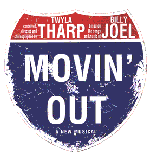
MOVIN' OUT -- A Review

Anyone who knows me knows I’m a huge Billy Joel fan. I’ve seen him on concert three times, and have wanted to see the Billy Joel inspired musical “Movin’ Out” since it opened on Broadway in 2002. It was nominated for nine Tony Awards in 2003 and walked away with two – Best Choreography (Twyla Tharp) and Best Orchestrations (Billy Joel and Stuart Malina). I was disappointed that it only won two awards, but it was up against “Hairspray,” which won eight that year.

The show landed in Madison this week, playing Overture Hall, and my younger sister and I attended the sold-out performance Friday night. First, I must say that this was the first chance I’d had to attend a performance at the new Overture Center for the Arts and must say it is beautifully designed and the acoustics to die for. The seats, while reasonably comfortable, are not designed for our super-size-it society, and I can see a great many people being uncomfortable in them. The one thing I like about the seating at Overture Hall over the Kohl Center is that, while both feature arena-style seating, Overture Hall has metal railings in between rows which is ideal for holding on to while making your way to your seat, and in assuring that no one will fall on you from behind (a realistic fear of mine since it happened to me the second time I visited the Kohl Center).

The set design is minimalistic, with few props — a car driven onto the set in the opening scene, a hill for the scenes representing the Vietnam War, a bar for scenes set in both Saigon and New York. The band performed on a metal platform elevated above and to the rear of the stage, which made it difficult for those in the balcony to see them, due to the proscenium stage. From where we sat third row in the balcony, we could only see the lead vocalist/pianist; the rest were faceless torsos.

The musical is a fusion of ballet and modern dance, "narrated" through the songs of Billy Joel by the lead pianist/vocalist, following the lives of five friends through the 60's, the Vietnam War and into the 70's. While the dancers were incredible, the lead singer was amazing, making every song his own. To quote my sister, "He was friggin' awesome!" Piano and lead vocals for tonight's show were performed by Matthew Friedman, and he was indeed spectacular. Needless to say, he received quite an ovation at end of the performance — louder than that for the cast even! And deservedly so!

The worst thing about the show (other than not being able to see the band) was NOT singing along to every song. As mentioned earlier, I've seen Billy Joel in concert three times and walked away hoarse every time. But, well...though it *was* his music, it wasn't exactly the sing-along-at-the-top-of-your-lungs event his concerts are. However, that did not keep me — or the rest of the audience — from tapping fingers or feet, bobbing heads in time to the beat, or even mouthing the words on occasion. *g*

In short, it was an enjoyable performance, and I would definitely see it again, if given the chance. Especially if Friedman were performing lead piano and vocals.


Click Here to read a review from the Capital Times.

Thursday, May 04, 2006

Mail Order Etiquette

This was inspired in part by Cyn's most recent blog post, Rant-- Directory Assistance, as well as personal experience with the mail order business. Though I'm sure 411 operators deal with far more verbal abuse than an order taker, we do get our share of rude individuals and idiots. As Cyn says in her post, be nice to me and I'll be twice as nice to you.

1. Write your order down before you call. Include part number, color and/or size if applicable, and complete description as printed in the catalog or on the website. We are not mind readers, and when you call something by a different name we A) may not know what you are talking about, or B) think you are refering to a different item than the one you want.

2. Get your credit card out before you call and have it in front of you. This will save us both time and frustration.

3. Get rid of distractions. Turn off the TV, radio, video games or anything else that may be heard in the background. Lock barking dogs outside or in a different room, keep children quiet and do not carry on a conversation with a third party. Not only will this make it easier for us to hear each other, it will make the order process go much faster.

4. Do not ask me to hold while you take another call. Phone etiquette dictates that it is extremely rude to put the person you called on hold in order to talk to someone else, not to mention that it is a waste of my time. Let the call go to voice mail and answer it when our call is concluded.

5. Speak slowly and clearly. When you mumble or talk at twice the speed of light it is quite difficult to understand what you are saying. Also speak loud enough to be heard, but not so loud you shatter an ear drum. When relaying name and address wait for the operator to prompt you for information so that she does not have to repeat questions and you do not have to repeat your answers. The operator has a form she must fill out and a certain order in which it must be done. Be patient and let the order taker lead you along.

6. We will do our best to accomodate you, but please understand that we are not God and there are some things that are out of our control, such as transportation issues (such as union strikes) and the weather. Remember, just because it's sunny where you are doesn't mean there isn't a blizzard, hurricane, tornado or flooding where we are. If UPS, FedEx or the post office grounds their vehicles due to bad weather, there is nothing we can do about it. Driver safety is more important than your package. Neither can we procur an item we do not have out of a magician's hat. Sometimes we do not receive materials from suppliers when promised, or the supplier is running far behind. Trust me, we do not like it anymore than you do, and give backordered items top priority when they come in.

7. Understand that errors do occur, and stuff does get damaged during shipping. If you receive the wrong item or faulty merchandise, we will be happy to send the correct item or make an exchange, but you do not need to be rude about it or bitch us out.

8. Plan ahead. Don't wait until the night before you're leaving on vacation to order a new swimsuit, camping gear or fishing tackle. You know when your vacation is. You also know when Christmas comes, and when hunting and fishing season opens in your area. We try to ship orders as soon as possible, but we are limited by shipper/post office schedules, as well as by what we have in stock. Whenever possible, place your order at least two weeks before you need it to allow adequate shipping time. Not only does it reduce stress, it saves you money as you will not have to pay extra for next day air or priority mail.

9. When ordering from outside the country, please remember that it takes at least 1-2 weeks via airmail. We have no control over this; neither can we do anything about a package hung up in customs. We fill the form out and address the package to the best of our ability, but sometimes a package may be flagged by customs for the most bizarre reasons. Case in point: orders shipping overseas by a stamping supply company were delayed because ink colors bore the names of food, such as "certainly celery" and "pumpkin pie." I am not making this up.

10. We are not responsible for delays in shipping caused by you not knowing how to properly spell your own name, the name of your street, or your city. We are not responsible for you not knowing your house and/or apartment number. If you leave off a number in your address, it will be delivered to the wrong address. If you tell us you live in "Middleton" and you are actually in "Middletown" -- you are at fault when the shipper cannot find you, not us.

11. Last but most important, be polite and refrain from cussing. Please and thank you go a long way, as does patience and a courteous tone.

Wednesday, April 26, 2006

Being a Better Neighbor

It’s a fact that many of us live in apartments, and that living almost on top of one another can lead to arguments and animosity. There’s a reason the old maxim, “Do unto others as you would have them do unto you,” has been around for so long. Common courtesy and respect for your neighbors can go a long way in easing tensions that are bound to surface from time to time.

First, be sure that you read any lease before signing it, and that you understand what is and is not allowed on the property. Make sure children and guests also know and follow the rules. Remember, you are responsible for their behavior and any damages as well as your own.

Here are some tips to ease apartment living and make you a better neighbor.

-- Pick up after yourself, your pets and your children. You may not own the property, and it may not be the ritziest building or complex in town, but that is no excuse not to take pride in where you live. Not only is littering illegal, it’s about having a little dignity in your surroundings. No one wants to live in a dump, or any place closely resembling one. Pick up your garbage, and have respect for trees, bushes and flowers. Not only do they improve the general appearance of a property, they improve the quality of life overall.

-- Most properties do not allow children to play in hallways or basements. Teach children not to run, stomp, yell indoors or slam doors. Even children as young as two years old are capable of understanding these rules. Playing should be an outside activity, unless they can do so quietly and without disturbing neighbors.

-- Be aware of the noise ordinances concerning your building, property and community. 10pm is usually considered “courtesy” hours, after which there should be no loud noise, but even so, no matter what time of day, any music or noise that can be heard outside your apartment is disturbing to and disrespectful of your neighbors. Do not run appliances like vacuum cleaners after 10pm, and do not start washing machines, dryers or dishwashers after 9pm, so that they will be done running before then. Guests are allowed, but should not bother neighbors. Similarly, do not blare car stereos while sitting in front of any building, or lay on the horn to get a friend or relative’s attention. It is lazy, rude and inconsiderate of others.

-- More properties are allowing pets these days, particularly cats, but also dogs. Many popular breeds are not a good fit for apartments, such as Labradors, Setters, Saint Bernards and so on. Small dogs that can fit in one’s lap are more ideally suited to apartment living. Dogs should not bark, and should obey the simple commands of sit, stay and heel. According to law, dogs are to be leashed, and owners are responsible for pets that bite or attack another dog or person. Also, though many properties rudely permit it, dogs do not belong above the ground floor. To allow it is not only rude and inconsiderate, but also irresponsible towards those living below them. No one wants to – nor should they have to -- listen to a dog romping over his head any more than he does a child.

-- Obey handicap signs. It is illegal to use or block a handicapped-parking stall without proper vehicle identification (license plate or mirror tag), and carries a hefty fine. This applies to all vehicles, even if you are just dropping something off, or will be “just a second.” Using that stall without proper ID is against the law, and that includes work vehicles such as cable installer, meter reader or phone repairman.

-- Security locked doors. These doors are for your protection, as well as your neighbors, but they only work when they are kept closed. Do not prop secured doors open, do not tamper with the locks, and do not loan out your key. It is not only your neighbor’s life and well-being at stake, but also your own.

-- Laundry facilities. Many properties have a communal laundry room. Washers usually run thirty minutes, dryers forty-five minutes to an hour. Please show courtesy towards your neighbors by promptly removing laundry when done. Set a kitchen timer to remind you when it is done, and do not leave laundry sitting in machines for hours on end or over night. If you cannot be there to remove laundry when it will be done, don't start it. If you do leave it sitting in the machines while you run off somewhere, expect it to be removed by your neighbors. Help keep the laundry room clean by emptying lint traps when you are done, and depositing trash in garbage cans. If there is no garbage can in the laundry room, take your trash with you.

These are a few simple guidelines that will make you a better neighbor, and will earn you the respect and appreciation of those living next to you.


Copyright HL Lester 2006


Friday, January 27, 2006

Marching to Mozart

"People err who think my art comes easily to me ..."
~Mozart


Today is the 250th birthday of Wolfgang Amadeus Mozart. Born in Salzburg, Austria in 1756, he toured Germany at the age of six, and at seven his music teacher father took him and his older sister on a three-year tour of Europe's royal courts. During his brief 35 years, he composed forty-nine symphonies, forty concertos, and a wide range of other works, including operas such as The Marriage of Figaro (1784) and The Magic Flute (1791).

I am probably one of the few people tohave ever marched to Mozart. Not by choice, mind you. Back in high school, we members of the orchestra were rehearsing for an upcoming winter concert. One of the pieces selected "Sleigh Ride," a light, fun piece that was harder to play than it seemed. Despite the level of difficulty, it was our favorite piece, and knowing this, the director used it as a carrot to get through the other pieces listed for the day's rehearsal. To be honest, I can't even recall the other pieces slated for that performance. It was the band's year for selections from "The Nutcracker Suite," not ours, and I think we did "A Yuletide Festival of Song" that year, but the rest is a blurt.

In any case, we were working through the Mozart one day -- working being the operative word, as we were not feeling the music, and were having trouble with one particular passage. Our rhythm was off and we were having trouble synching with each other. Our instructor's solution? Everyone but the cellos were made to stand up and march while playing.

Have you ever tried to march while playing a violin or viola? Go ahead -- try it. Even if you don't have an actual instrument in your hand, stand up. Pretend you are holding a violin to your left shoulder, and march while making a bowing motion with the right. See how long you can keep it up before you step out of synch.

It ain't easy.

Your feet are going one direction, the bow in another, making it extremely difficult. It must have worked, however, as we eventually did get it. It just took a few more days of marching.

I think the lesson in all this can be applied to writing. If what you're working on isn't working, approach it from another direction. Maybe you're a plotter and not a pantster, or perhaps you lose all interest in a story if every detail is plotted out. If a chapter doesn't seem to be working, back up to where it was last flowing and see if maybe your characters want to go in a completely different direction. Change the locale, or the POV, or maybe even a character's name. Listen to the music, yes. But if you get out of synch with the rhythm, try marching to Mozart.

Tuesday, January 17, 2006

Oprah Picks Wiesel's NIGHT

Oprah Winfrey announced Monday that her latest book club pick is Elie Wiesel's compelling autobiographic account of the Holocaust, NIGHT. More than one million copies of the book have been published by Farrar, Straus in both paperback and hardcover, and by Monday afternoon the book's Amazon sales ranking was at 21, and is currently at #3.

NIGHT is about Wiesel's survival as a teenager in the Nazi death camps, where he witnessed the deaths of family members. Originally written in French in the 1950s, it attracted little notice at first. "The English translation came out in 1960, and the first printing was 3,000 copies," he said. "And it took three years to sell them. Now, I get 100 letters a month from children about the book. And there are many, many million copies in print."

Said Winfrey during her show on Monday, "Like Dr. King I have a dream of my own, too, that the powerful message of this little book would be engraved on every human heart and will never be forgotten again. That you who read this book will feel as I do that these 120 pages ... should be required reading for all humanity."

I vehemently agree.

I first heard of the book when a section of it was assigned for a college course. It was so forceful that even that little bit remained with me so that, years later when I saw stacks of it sitting on a bookstore table, I felt compelled to buy and read it in its entirety. Though it is definitely not light reading, NIGHT should be read by all ages and nationalities, so as not to forget the horrors of the Holocaust, or, as Wiesel puts it, “man’s capacity for inhumanity to man.” It seems especially more imperative that we remember, that we never forget, after the recent denouncement of the Holocaust by the new Iranian president as a “myth” perpetuated by the U.S. and European community.

Wiesel is the author of more than 40 books, essays and plays, and has won the Presidential Medal of Freedom and the Nobel Peace (1986). Although many bookstores market NIGHT as a novel, Wiesel's foundation labels it a memoir.

In one passage, he sums up his feelings upon arrival in Auschwitz:

"Never shall I forget that night, the first night in camp, which has turned my life into one long night, seven times cursed and seven times sealed. Never shall I forget that smoke. Never shall I forget the little faces of the children, whose bodies I saw turned into wreaths of smoke beneath a silent blue sky. ... Never shall I forget these things, even if I am condemned to live as long as God Himself. Never."

Winfrey also said on Monday that she plans to travel with Wiesel to Auschwitz in February, and her show will have a high school essay contest on Wiesel's book. Fifty winners will be flown to Chicago for a taping of her show with the author.


Buy the book now:
Barnes & Noble
Amazon

Wednesday, January 11, 2006

Sloppy editing

Every now and then you stumble across a site you can't help going back to--again...and again...and again. One of those sites is A Newbie's Guide to Publishing, the blog of J.A. Konrath, writer of the Lt. Jacqueline "Jack" Daniels series. Konrath tells it like it is, enlightening both the pros and newcomers of the writing world.

A recent post of his that garnered a number of comments was based on his recent experience judging a writing contest, and how he can tell how good a story is by the first sentence or two. He goes on to instruct in the proper formatting of a story for submission, whether for a contest or agent/publisher. Having experience as a newsletter editor, I know where he is coming from, and can only agree with what he says. Some of his advice is common sense, such as making sure there are no typos or spacing issues, and that your first sentence--heck, the entire first paragraph--grabs a reader's attention, but it never hurts for even the more seasoned writer to be reminded of some things.

Like Konrath, I have trouble reading past the first sentence if there are a lot of errors. I used to feel bad about this, particularly on message boards, but--in my opinion--there is no excuse for lazy writing. Especially on a website or blog geared towards writers. Writing properly at all times improves one's writing, one's grasp of language and grammar. If you claim to be a writer, use proper English, capitalizing the pronoun "I" as well as the first word of any sentence, at all times. You will garner more credence as a writer, whether you have been writing for years or have yet to publish. First impressions truly are important, and if you can't be bothered to write a proper paragraph on a message board, how is anyone to believe you are a good writer, that your book is worth not just buying, but reading and referring to friends?

During my stint as a newsletter editor, the submissions I saw ranged in various degrees of polishing. One regular contributor never sent me an unclean article. In over a year of working together I questioned only one word in one submission--and she agreed that my suggested change was better. Other writers would send material that needed only a minimal of editing, a typo here or there. The submissions I received from a multi-published author, however, were horrifying.

This was an author published in both fiction and nonfiction, and her submissions were so riddled with typos, spacing problems and inconsistent formatting that it would sometimes take hours to clean them up. I refuse to believe that any professional author, especially one with as many books out as she, would ever think of sending something like that in to an editor, yet she apparently thought so little of me--so little of our publication--as to consistently submit unpolished material, and usually past deadline as well. I will not lie in that it lowered my esteem for her considerably. In fact, whereas I was once a huge fan of hers, I will no longer even look at one of her books, let alone buy it. How can I be sure of getting a quality product when I have seen the lack of quality in her submitted work?

It isn't solely this one author, however. I've become equally less enamored of an entire series put out by a publisher. Why? Because in two different books, one published in November and one in December, I found the same type of error that 1) should have been caught by the author and at the very least 2) should have been caught by the editor or copy editor. I know that, as a writer blessed with an internal editor, it may have been more obvious to me, but I cannot believe I am the only person to catch these mistakes. Readers are very astute, and I can recall a discussion of a mini-series on one message board in which the method of how a bracelet came to be lost was different in two back-to-back episodes of the series. In one, the bracelet was stolen; in the next it was lost and recovered by a suspicious character. Readers picked up on this immediately and railed on it.

In the case of the more recent incident, the error involved who was performing an action. I will not embarrass the writers or the publisher by naming names, but am sure anyone who has read these books will recognize them immediately. In the first book, a husband and wife are in a truck listening to a news report. The husband snaps off the radio and exits the truck. Not more than a page later, the wife reaches over to the radio--which had not been turned back on!-- and shuts it off.

In the second book, a couple enters a diner and places an order, including coffee. The waitress leaves to submit their orders, and it says, "It was the owner who brought their coffee." They talk for a couple pages, the owner leaves, and suddenly the waitress appears with their coffee. Not with a refill, but with the initial cups of coffee!

This kind of mistake is inexcusable.

With the first book, I was especially disappointed as it was a local author I have met and whose books I have always enjoyed. When the same type of mistake occurred in this series of books by a different author, I was angry. I felt betrayed as a reader and a book buyer. When you lay down money for a book, whether in print or ebook format, you do so with the expectation of receiving a quality product. It is first up to the writer to submit the best book she can, smoothly polished and with a gripping story. It is next up to the editor to make sure that the material submitted is as good as it can be. Anything less than that is a betrayal to the reader, and can only reflect back on the publisher (and the writer) in the form of fewer sales. I know I personally have reservations about ever buying this series--and even from this publisher--again.

Inconsistency can be a major story killer, and reading for it should be an integral part of the editing process. I've heard of books where the hero's name suddenly changed. Not just from a given name to a nickname, but from Bob to Ted with no explanation other than a writer changing the character's name and not fixing it all the way through the manuscript.

Not too long ago, a friend was asked to review a book for her website. Though she eagerly agreed, she found herself unable to write a favorable review. The reason? Sloppy editing. Both the heroine's skin and hair color changed throughout the book, with no apparent reason other than the writer possibly writing the heroine initially as one race, then changing her mind. While a white character becoming black during the story might have worked in John Updike's BRAZIL, it is not advised for the average writer. Readers will notice, and be quite disgruntled with the error.

As writers, we have an unwritten contract with the reader to deliver a quality product: a good story, clean copy, and consistent and believable plot. When these criteria are not met, we risk alienating, and even losing, the reader. Not only will she not finish this particular book, she will be unlikely to read another, and will suggest her friends avoid you as well.

Few writers actually enjoy the editing process, yet it is an integral part of the contract with the reader--and the publisher. It begins with you, writing the best product you can and making sure that it is clean and consistent before submitting it. It next becomes the editor and copy editor’s obligation to make sure that the story is clean and accurate. When editing and proper formatting become inconsequential, an injustice is committed towards the reader. You owe it to your readers--be they judges, publishers, or consumers--to submit only the highest quality of work you can produce.

To do less is a breach in contract with the reader.


Recommended reads for strengthening grammar and editing skills:

SELF-EDITING FOR FICTION WRITERS by Renni Brown and Dave King
ON WRITING WELL by William Zinsser
THE ELEMENTS OF STYLE by Strunk & White
WOE IS I by Patricia T. O'Conner


Monday, December 19, 2005

Happy Holidays

HAPPY HOLIDAYS

(The opinions expressed below are those of the blog owner. If you don't like it, you don't have to read it!)


This “holiday” thing is getting out of hand – and I blame Bill O’Reilly and his ilk for trying to steal people’s joy and divide the nation at a time of year that usually symbolizes peace and unity.

For those who missed it, O’Reilly and the Christian Coalition (read: radical fundamentalists) are waging a war on the phrase "Happy Holiday(s)." Their lack of research to the phrase’s origins before going on the attack is blatantly obvious.

First, neither democrats nor liberals invented the phrase "Happy Holiday(s)," nor are they trying to “steal Christmas.” The phrase has been around longer than there have been democrats and republicans, and the last thing we need right now is people who willfully attempt to divide people. It’s particularly odious this time of year, when people speak of "Peace on earth, good will to men." Apparently for some, that goodwill only extends to those who share their narrow-minded views.

Second, the Irving Berlin song "Happy Holiday" was written in 1942 and introduced in the Bing Crosby classic movie "Holiday Inn." The phrase predates that by quite a bit.

Third, I’m more than willing to call an evergreen draped in tinsel and lights a Christmas tree (I have all my life!) – so long as Christians concede it has nothing to do with Christ, but is actually a pagan symbol of the winter solstice adopted as a "Christian" symbol by converts reluctant to completely leave behind their pagan ways.

"Historians agree that through the subsequent centuries, traditions from ancient pagan (non-Christian) religions became intertwined with those of Christianity, and depending upon one's point of view, either paganism became Christianized, or Christianity became paganized." (Article: Christmas in America becomes battleground)

Fourth, it’s called "winter" break, same as there’s a fall break, spring break and summer break. It is a break that occurs around the beginning of winter, and just happens to coincide with Christmas – as well as Hanukkah and Kwanzaa. By the same token, a school or community concert at this time of year is legitimately a "winter concert" – and yes, there are spring concerts as well. I played in both through high school, and our programs included both seasonal selections ("Yuletide Festival," Mozart’s "Sleigh Ride" and selections from "The Nutcracker Suite") as well as non-seasonal selections. Granted, I think rewriting the lyrics of traditional Christmas carols goes a bit too far, but as long as other selections are included, I see nothing wrong with choirs or bands playing a Christmas carol or two. In fact, one of the things I miss most about college was the annual Christmas concert – a truly spectacular event. And watching "Holiday With the Pops" and the St Olaf’s concert has become a Christmas Eve tradition. I think there is nothing better than to be exposed to carols from around the world, or music from other faiths. Music is universal, no matter what might be on the program. It is the one language you don’t have to be fluent in to truly appreciate it.

Fifth, people of many different faiths celebrate Christmas, in some capacity of another. I know Muslims who celebrate it in addition to their own holy days. I know atheists who celebrate Christmas as a time of peace and giving. The holiday doesn’t have to include Christ in order for it to have deep meaning for people. Religion is a very personal matter, and while some have deeply rooted Christian beliefs, others’ beliefs are not so strictly regimented, or may be formed from a more universal upbringing or education.

Sixth, the word "holiday" means "holy day" and through the centuries has come to have a more Christian context. The "Holiday Season" originally referred to not just Christmas, but first Michaelmas (a huge feast day at the end of September), then later Boxing Day (a day when alms were given to the poor), and Epiphany (when the wise men are said to have arrived in Bethlehem) — three of which are not recognized or celebrated in the US, but are by other countries. Now, of course, the "holiday season" has been expanded to include Thanksgiving, Hanukkah, and Kwanzaa and that, for some inexplicable reason, offends some Christians.

My beliefs are not yours, as yours are not mine. I tend to hold more Unitarian views on religion than most of my friends, but I am proud to count Christians, Wiccans, Atheists and people of other religious persuasions among my friends and family. And, I’ll allow, I am much richer for the experience than those who do not welcome views that contradict their own.

It may in fact surprise most Christians to know that "Christmas" was not one of the original holy days celebrated by the church, and that it was banned by English Parliament in 1644, which demanded shops stay open that day, and condemning plum puddings and mince pies as "heathen." In this country, Christmas was not celebrated by early settlers (many Christians still do not celebrate it), and it was even suppressed by the Puritans. In Massachusetts between 1659 and 1681 it was illegal to celebrate Christmas, the fine being five schillings. It was not until the 19th century that Christmas was legally recognized.

Even Christian evangelists such as Garner Ted Armstrong of Tyler, Texas has proclaimed for more than 45 years that, "It is impossible to 'put Christ back in Christmas,' since He was never in Christmas in the first place! None of the apostles of Christ ever heard of the term; not one of them ever celebrated Christ's birthday."

And while we are on the subject, abbreviating "Christmas" with "Xmas" is perfectly legitimate and does not, as many errantly believe, remove Christ from Christmas. The letter "X" represents the Greek letter chi, the first letter in the Greek word Χριστός, which means "Christ."

Do I celebrate Christmas? Yes. Do I celebrate it as the birth of Christ? Not really. To me, as with many of my friends, Christmas is a time of family and of giving. That does not mean it is a meaningless time of year for us, but perhaps more meaningful. Though we give to charity year-round, we pay particular attention to our local community this time of year, donating toys to needy children and blankets to Hospice Care. We not only give to The Salvation Army (recognizing that they serve all people, not just Christians in need), but also teach children we know the importance of giving, and of sacrifice.

How each of us chooses to celebrate this time of year is of no one’s concern but our own. The Bill of Rights grants us the freedom to worship as we wish, or not. It is also supposed to ensure that no one religion or denomination is imposed on the masses, a fact that seems lost by many in this great land of ours. If you want me to respect you and your beliefs, then please "do unto others" and accord me the same. No matter how or what you celebrate, this is a joyous time of year, and neither that fact, nor the message of "Peace on earth, good will to men" should ever be forgot.

For more on the historical origins of the Christmas celebration, I highly recommend The History Channel or this article at World Net.


And to you and yours, peace on earth,
good will towards all, and happy holidays!