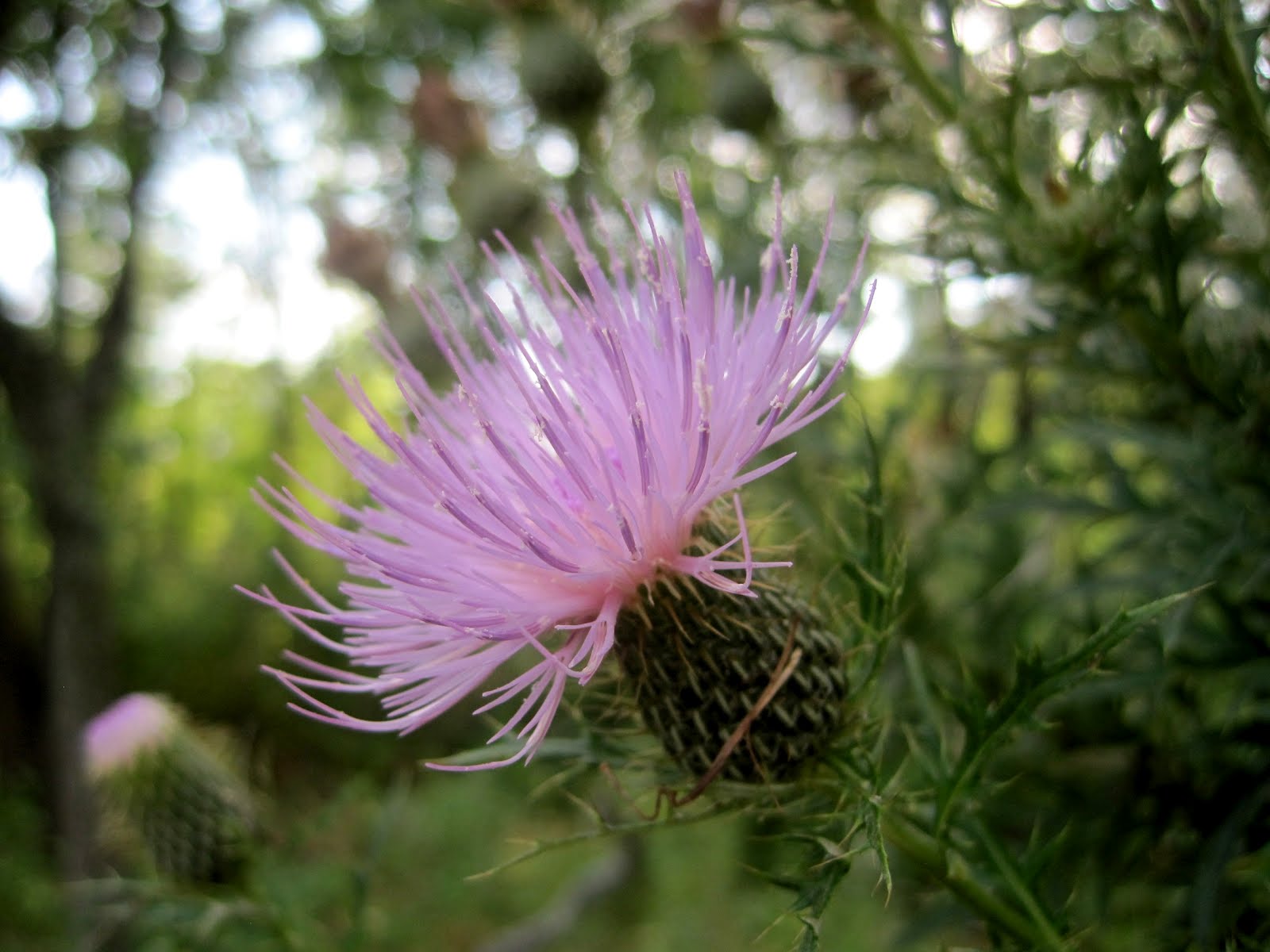
Last week I promised pictures of some of the prairie plants I learned to identify on a recent guided walk through Greene Prairie, a part of the
UW Arboretum here in Madison. It is a 50-acre restored prairie planted primarily by one person, Henry Greene, during the 1940s and 1950s. Many of the plants I am going to talk about are pictured in the photo I used for this week's header. All photos were taken by me—click on any one of them for a larger view.
 Spiderwort.
 This is one of the prettiest and most easily recognizable of wildflowers, and one of my favorites. With 71 species, these plants are native to the New World from southern Canada south to northern Argentina, and grow in wooded areas and fields. The flowers can be white, pink or purple but are most commonly bright blue. Some species flower in the morning and then close up in the afternoon when the sun is shining, but flowers can remain open on cloudy days until evening. Though sometimes considered a weed, it is often cultivated for containers.
Click here to see my Spiderwort and Bee, posted last weekend.
 Golden Alexander
 is a hardy member of the carrot family. The leaves and fruit of this plant turn purple in the fall. Though it prefers wet habitats, it is sturdy enough to survive dry summers.
 False White Indigo
 or
Baptisia is another pretty flower I like. While it can be seen on both restored prairies of the Arboretum, it seems more abundant at Curtis Prairie, located along the southern edge of the main part of the Arboretum. Curtis Prairie is the oldest restored prairie in the United States.
 Prairie Phlox
 is another pretty flower that grows in both woodlands and prairies, as well as alpine tundra. There are 67 different species found primarily in North America. Flowers can be white, pink, purple, blue or red.
 Puccoon.
 I know, what an awful name for such a pretty flower, right? The word '
puccoon' denotes the plant as a source of a dye–a reddish color that was used by Amerindians for pottery, basketry, and personal ornament in various ceremonies.
 Equisetum
 or
Horsetail. This is one of the oldest plants in the world, dating back one hundred
million years. It is considered a "living fossil," and some
Equisetopsida in the Paleozoic era grew as large as trees. This plant is found on every continent except Antarctica, in wooded areas as well as prairies.

This
itty bitty flower is a
Bluet, or
Quaker Lady, and only grows in one spot of Greene Prairie,
preferring well-drained sandy loam and full sun. They are ideal for rock gardens.
 Compass Plant.
 This plant earned its name as they tend to align their foliage East-West to present the minimum surface area to the hot noon sunshine. A mature plant ranges from 6-12 feet tall, with 6-30 large yellow flowers of 3-4 inch diameter (they are not yet in bloom at Greene Prairie). It is usually found in tandem with...
 Prairie Dock.
 Its big green leaves are easily recognizable when gazing out at any prairie, as they are up to 18" long and 12" wide. Stalks up to 10 feet tall will sprout from the center, topped with
yellow flowers.

These small, daisy-looking plants are known as
Prairie Fleabane, and they are a 'lesser' daisy. They grow in both woodlands and prairies, as well as ditches. In fact, there are some growing behind my apartment complex. They are 1-3 feet tall, with 50-100 white flowers, often with several flower heads on a single stalk. Prairie f
leabane can be found in almost every state of the continental US.
 Penstemon.
 Also sometimes known as
Beard-tongue,
penstemon are most common across North America and Europe. There are 63 known species, and flowers are mostly purple, but can also come in red, white and orange. Native Americans used
penstemon roots to relieve toothache.
 Rattlesnake Master.
 Common in eastern and central North America, from Minnesota east to Ohio, and south to Texas across to Florida, some Native Americans used its root as an antidote for rattlesnake venom (hence the name). They have bristly or spiny leaves with a sharp tip, and will eventually be topped with greenish-white or bluish-white
flowers.
 Yellow Star Grass
 is actually not a flower, but an ornamental grass, and is also one you might see along roadways.
LINKS TO OTHER THURSDAY THIRTEENS:
(Please leave your link if this is your first visit!)
Adelle Laudan * Shelley Munro * Kimberly Menozzi
Hootin' Anni * David Bridger * Harriet * Kristen
Darla M Sands * Janet * Jill Conyers * Paige Tyler
Robin Rotham * Tatiana Caldwell * CountryDew
Alice Audrey * Janice Seagraves * Inez Kelley
Jennifer McKenzie * Alexia Reed * Elise Logan
Colleen * Felicia Lind
More Thursday Thirteen participants


 This photo is from one of my favorite experiences. I went walking up at the Arboretum in early July, just before sunset and on a whim decided to wander down to Greene Prairie. Boy was I glad I did! This young doe and a young buck (I think they are the twin fawns I kept seeing last year) were both grazing in the meadow and came within a few yards of me.
 January. Nothing chases away the winter blues like fresh fruit.
 February. I happened to have my camera close at hand while watching a welcome home celebration for the Green Bay Packers after they won the Super Bowl, when they zoomed in on this poster held up by a fan. Here's to keeping that trophey at home this year!
 Mid-March in the Arboretum, about a week after a spring blizzard that left several inches of snow in its wake. As you can see, it was melting fast!
 April. Spring buds in the Arboretum.
 May. Teal Pond Boardwalk, UW Arboretum.
 June. I snapped these gorgeous tulips at the Farmer's Market early in the month.
 July. These cuties shared a nest outside the door at work (there's actually a fourth baby hiding at back of nest). While Mama did not dive-bomb those coming or going, she sure did scold.
 August. Butterflies in Bloom exhibit at Olbrich Gardens. You can see more photos from this event here.
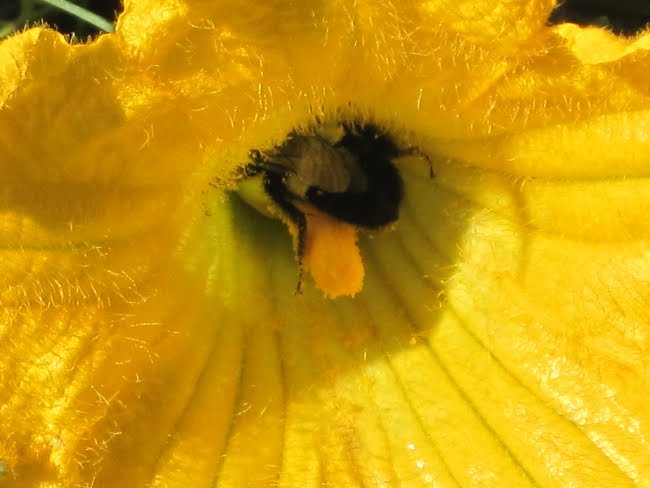 September, and the bees were extra busy.
 October. The Bittersweet was holding on during a gorgeous Indian Summer mid to late October.
 November. Nothing like an Autumn walk in the Arboretum—leaves crunching under foot, a pungeant smell in the air... And yes, it was still this green in November. Pathetic!
 December. There has been a dearth of snow round these parts, so I am afraid I cannot offer the usual snow-covered vistas normally typical this time of year. We have only had a bit over four inches of snow this season—about fifteen inches below normal. The poor plants are becoming confused—and they aren't the only ones!
  I love the vibrant red of Sumac in the fall!
 Some Middle Eastern cultures grind the fruit (called drupes) of sumac to use as a lemony-flavored spice. The drupes were also used in many medieval medicines, particularly in Islamic countries, and as a dye. One interesting fact I read is that an 11th century shipwreck, excavated off the coast of Rhodes in the 1970s, contained large enough quantities of sumac drupes to be use as a spice, dye or in medicines.
 Spiderwort. This is one of the prettiest and most easily recognizable of wildflowers, and one of my favorites. With 71 species, these plants are native to the New World from southern Canada south to northern Argentina, and grow in wooded areas and fields. The flowers can be white, pink or purple but are most commonly bright blue. Some species flower in the morning and then close up in the afternoon when the sun is shining, but flowers can remain open on cloudy days until evening. Though sometimes considered a weed, it is often cultivated for containers. Click here to see my Spiderwort and Bee, posted last weekend.
 Golden Alexander is a hardy member of the carrot family. The leaves and fruit of this plant turn purple in the fall. Though it prefers wet habitats, it is sturdy enough to survive dry summers.
 False White Indigo or Baptisia is another pretty flower I like. While it can be seen on both restored prairies of the Arboretum, it seems more abundant at Curtis Prairie, located along the southern edge of the main part of the Arboretum. Curtis Prairie is the oldest restored prairie in the United States.
 Prairie Phlox is another pretty flower that grows in both woodlands and prairies, as well as alpine tundra. There are 67 different species found primarily in North America. Flowers can be white, pink, purple, blue or red.
 Puccoon. I know, what an awful name for such a pretty flower, right? The word 'puccoon' denotes the plant as a source of a dye–a reddish color that was used by Amerindians for pottery, basketry, and personal ornament in various ceremonies.
 Equisetum or Horsetail. This is one of the oldest plants in the world, dating back one hundred million years. It is considered a "living fossil," and some Equisetopsida in the Paleozoic era grew as large as trees. This plant is found on every continent except Antarctica, in wooded areas as well as prairies.
 This itty bitty flower is a Bluet, or Quaker Lady, and only grows in one spot of Greene Prairie, preferring well-drained sandy loam and full sun. They are ideal for rock gardens.
 Compass Plant. This plant earned its name as they tend to align their foliage East-West to present the minimum surface area to the hot noon sunshine. A mature plant ranges from 6-12 feet tall, with 6-30 large yellow flowers of 3-4 inch diameter (they are not yet in bloom at Greene Prairie). It is usually found in tandem with...
 Prairie Dock. Its big green leaves are easily recognizable when gazing out at any prairie, as they are up to 18" long and 12" wide. Stalks up to 10 feet tall will sprout from the center, topped with yellow flowers.
 These small, daisy-looking plants are known as Prairie Fleabane, and they are a 'lesser' daisy. They grow in both woodlands and prairies, as well as ditches. In fact, there are some growing behind my apartment complex. They are 1-3 feet tall, with 50-100 white flowers, often with several flower heads on a single stalk. Prairie fleabane can be found in almost every state of the continental US.
 Penstemon. Also sometimes known as Beard-tongue, penstemon are most common across North America and Europe. There are 63 known species, and flowers are mostly purple, but can also come in red, white and orange. Native Americans used penstemon roots to relieve toothache.
 Rattlesnake Master. Common in eastern and central North America, from Minnesota east to Ohio, and south to Texas across to Florida, some Native Americans used its root as an antidote for rattlesnake venom (hence the name). They have bristly or spiny leaves with a sharp tip, and will eventually be topped with greenish-white or bluish-white flowers.
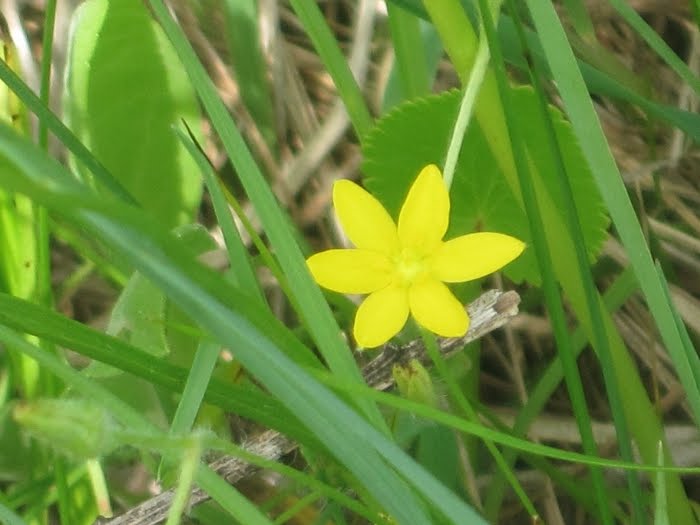 Yellow Star Grass is actually not a flower, but an ornamental grass, and is also one you might see along roadways.