An ad recently posted along Washington DC metro lines by the Greater Washington Initiative is gaining attention – and not of the positive sort. First brought to my attention by Amanda Brice at Romance Divas, it has been a heated topic on other forums and blogs across the Internet, including Smart Bitches. On one side the ad depicts a man in a business suit reading a romance book (an actual title currently in print), with a caption above that says, "Average subway reading." On the other side is this same man reading Plato with the caption, "Greater Washington subway reading." Below that is text that states that the most educated work force in the nation is in Washington DC, with 45% of the population having a bachelor's degree or higher.
There are several things about this ad that are bothersome. Though there are men who read and write romance, the primary readers and writers being female makes this ad condescending towards women, as well as sexist in nature. It implies that if you read romance, you are inferior, both intellectually and biologically, when in fact statistics show that 42% of romance readers have a bachelor of arts or higher. That means that, allowing for a 3% margin of error, romance readers are -- GASP! -- just as intelligent as someone who reads Plato. They’re just not as pompous.
Second, the fact that it targets romance as opposed to horror, science fiction or manga, is also insulting, though no surprise. Literary snobs seem to forget that the "classics" they hold in such high esteem were not deemed as such when they were written. In fact, Mark Twain, William Faulkner and Charles Dickens all wrote what was considered "pulp fiction" in their day. What makes great reading is subjective, and a classic is something that holds a timeless appeal and speaks to the masses. One cannot write a “classic.” No matter the genre, one writes the best work one is capable of, and hopes that it finds an audience.
The truth is, no matter one's sex, or the genre for which one writes, writing is hard work. It is as difficult to pen a 300-page romance as it is horror, mystery or something more "literary." All must hone their craft. All must learn the basics of sentence structure, grammar, editing, and plotting. All must put in hours, weeks, months and even years of time in front of the notepad or keyboard. Just because one writes romance, doesn't mean one is a hack. There are hacks in all genres, yet romance is the only one to which this stigma remains attached.
To be fair, the romance industry can be its own worst enemy. Though not quite the “bodice rippers” of the 1970s and 80s, the clinch covers and trite titles that often grace these novels, particularly those of Harlequin/Silhouette, convey the message that romance readers are so dumb they need the entire book summed up for them by covers that read “The Tycoon Cowboy’s Secret Baby” or “His Runaway Amnesiac Virgin Bride.” Pu-lease! If the romance industry wants to rise above the stereotype, the first step is to abandon this practice. Give books real titles and it will go a long way in validating the genre.
Third, there is the obvious fact that the GWI failed to do their homework before initiating this ad campaign, or they would have known the statistic cited above regarding romance readers. Even if one is not familiar with Romance Writers of America, the facts are easily accessible by doing a Google search on "romance statistics." Such a search leads you directly to RWA’s facts on romance—who reads them, their level of education, and the fact that fifty percent of all paperbacks sold are romances. That’s right, half of all paperbacks! That means that horror, mystery, fantasy, science fiction, nonfiction and all other genres and subgenres combined equal the number of romances sold each year. How can that many readers be wrong or considered inferior? It has also been my observation that, more than readers of any other genres, romance readers are more likely to read outside their preferred genre.
Not only are the readers intelligent, but so too are the authors. Many are or have been teachers, lawyers, FBI agents, or computer programmers. One romance author I know was a Pushcart Prize finalist—one of the most prestigious awards for short fiction, poetry and essays. I personally have a BA in French and English with a writing emphasis. While I confess that I have not read Plato, I have read many other ancient dead guys: Molière, Sartres, Camus, Shakespeare, Dickens, Twain, and many other French, British and American writers. Some I liked; some I did not. Some I found positively brilliant, while others the worst writing I'd ever been subjected to.
While the French has grown a bit rusty over the years, I am still fully capable of reading—and understanding—anything read in that language. Though I am partial to reading romantic suspense, authors such as Jimmy Carter, Mitch Albom, Carson McCullers, Lisa Scottoline and Joan Didion vie for space on my nightstand along side Toni Blake, Heather Rae Scott, Nora Roberts, Ann Voss Peterson and Rebecca York.
What bothers me most in all this—and judging by various blogs and discussions around the Internet, I’d say it is universal among the romance community—is the fact that the GWI would denigrate someone for reading anything at all. In an age when fewer books are sold, when reading skills in general are below average across the nation, and in a country that has one of the highest illiteracy rates among First World Nations—their ad criticizes people for their choice in reading material, when the fact that they read at all should be lauded.
People should not be made to feel inferior for their choice in reading material, be it romance, horror, manga, or even Plato. We need to encourage and promote reading in all its forms, not solely what is considered "classical" or "literary."
Just as a book shouldn't be judged by its cover, neither should someone be judged by what he or she chooses to read...or write.
Friday, October 20, 2006


Monday, October 16, 2006
Stuff On My Cat
I saw the link to this site in today's PW Daily enewsletter and had to share: Stuffonmycat.com. I'm sure we've all experienced funny moments such as these with our kitties. Check out their lefthand sidebar on how YOU can submit your own photo of stuff on your cat!
I particularly liked this one:

I particularly liked this one:

Soldiers' Orphans
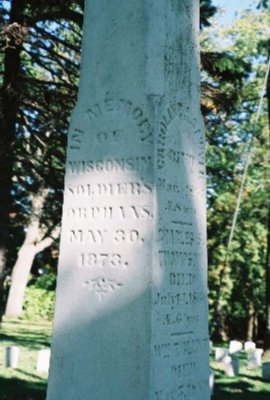

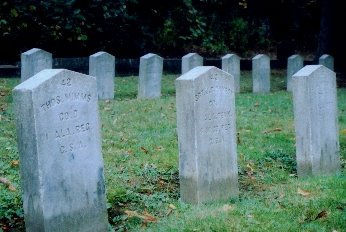
These two pictures are of small tombstones and accompanying obelisk in the center of Soldiers Lot, the Union graveyard at Forest Hill Cemetery.
As you can imagine, the Civil War left behind a large number of parentless children, their fathers killed during battle and their mothers either dying themselves or unable to support them. In 1866, the Harvey Hospital located near Spaight and Brearly was transformed from a soldiers' hospital to an orphanage. 683 children lived at The Soldiers' Orphans home over the course of its nine years, it's mission to care for children age 4 to 14 whose fathers had been killed during the Civil War. Eight of the children were buried here, the youngest only four years old and misidentified on the large obelisk.
Saturday, October 14, 2006
Ivy's Last Hurrah

An abandoned building on University near Highland -- I loved the play of light and shadows over the ivy dressed in Autumn splendor.
Friday, October 13, 2006
The War of 1812

"Well, in eighteen and fourteen we took a little trip
along with Colonel Jackson down the mighty Mississip.
We took a little bacon and we took a little beans,
And we caught the bloody British near the town of New Orleans."
The above lyrics are from the 1959 Grammy winning Song Of The Year, The Battle of New Orleans, written by high school principal and history teacher, Jimmy Drfitwood. Athough the lyrics say "1814," this now famous penultimate battle of the War of 1812 was actually fought in January 1815 -- call it poetic license. Though I grew up listening to this song, I did not know until this year's "Talking Spirits" tour that there was actually one battle fought in Wisconsin. History classes teach the Burning of Washington (remember Dolly Madison?) and Andrew Jackson's heroics in the Battle of New Orleans.
What is rarely mentioned even here in Wisconsin is that, in June 1814, British troops captured Fort Shelby at Prairie du Chien, and controlled the fort and territory until the 1815 Treaty of Ghent returned Wisconsin to the United States. Four veterans of the War of 1812 are interred at Forest Hill, including David Jaquish, who would have been 19 when the war began. Despite these early animosities, the United States and Great Britain have remained staunch allies ever since.
Wednesday, October 11, 2006
Forest Hill: Oakey marker
 Nature's destructive forces at work
The Oakey obelisk is one of many deteriorating markers within Forest Hill Cemetery, and also one of few made of sandstone. A stonecutter by profession, one would have thought William Oakey (1824-1892) would choose a more durable stone for the family plot, but there you have it. As you can see, there is a vertical crack dividing the marker, a huge chunk is missing near the top, and the words faded and near impossible to read . You'll also note a pointed piece near the base, which once sat atop the obelisk. There are many markers in such condition -- or worse.
There are two schools when it comes to dealing with old tombstones such as this, ones either fallen or deteriorating. Some believe they should be left to fate and the elements, that no repairs, or attempts to right or repair them, should be taken. Others believe that every effort should be made to preserve and protect a marker, and that one in great disrepair should be fixed or replaced, so as not to lose the vital family history carved in it.
The Oakey obelisk was on this year's “Talking Spirits” tour as an example of not only a marker that is deteriorating, but also one replaced by descendents. The family did not, however, choose to remove it, but left it standing to fall as it will. One can only hope that when that day comes, it doesn’t take out the newer marker standing behind it.
Tuesday, October 10, 2006
Talking Spirits VIII: Alice Whiting Waterman, Guardian of Confederate Rest
“When in the Course of human events it becomes necessary for one people to dissolve the political bands which have connected them with another and to assume among the powers of the earth, the separate and equal station to which the Laws of Nature and of Nature's God entitle them, a decent respect to the opinions of mankind requires that they should declare the causes which impel them to the separation.”
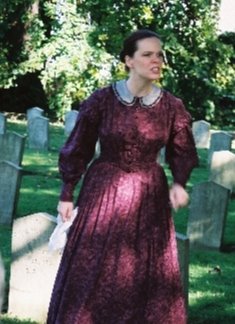
You may recognize these words as those of Thomas Jefferson, and the opening paragraph of the Declaration of Independence. They were also the words uttered by Liz Angle as she greeted us in her role as Alice Whiting Waterman at the final stop on this year’s tour, Confederate Rest.
Confederate Rest is the northernmost Confederate graveyard and is located within Forest Hill Cemetery. 140 of the thousand plus Confederate POWs sent to Camp Randall are buried here. All but one died within weeks of their arrival, sick as they were with pneumonia or other diseases. The people of Madison turned out with bands to greet the train carrying the first load of prisoners, most of whom were part of the 1st Alabama Infantry captured at Island No. 10 in the Mississippi River. Others captured were members of the 1st Alabama, Tennessee & Mississippi Regiment. The sickest of the prisoners were ferried north via boat, the train being deemed too risky for their health, yet men who were already suffering from pneumonia or serious battle wounds were left lying on an open deck, exposed to the harsh wind and rain of a northern spring. Citizens brought food, clothing and reading material to prisoners daily, and attended the sick as best they could, but many were too far gone to recover, and were laid to rest in a “potter’s field” at Forest Hill.
Though she knew none of them, Alice felt a deep affinity for her fellow southerners, though she herself had lived in the north since the age of ten. These 140 were “her boys.” She held them in great esteem for the depth of their convictions, right or wrong, for these boys — and many of them were mere boys — believed wholeheartedly in the cause for which they fought and died, and were the embodiment of the words of Thomas Jefferson.
When Alice Whiting Waterman arrived in Madison in 1868, six years after these Confederate soldiers were laid to rest, she found their graves overgrown with weeds and fallen in disrepair. She fell to her knees to pull weeds and returned, day after day, until she had completely cleared the tiny plot, for no matter what side they were on, they deserved better than this in death. She planted hickory trees to protect their graves from the heat of summer and harsh winter winds. With the assistance of Lucius Fairchild, she raised funds to build a wooden fence around the plot, later replaced with a low stone wall, and saw that the worn wooden “headboards” were replaced with stone markers containing name, company, regiment, state and date of death. Alice diligently tended her boys for thirty years, and was laid to rest along side them, as was her final request. Following her passing in 1897, Rev. J.W. Cochran, of Christ Presbyterian Church, paid tribute to Alice Waterman as a prelude to his Sunday sermon, and can be read here.
This was the same year that Madison first celebrated Memorial Day. All businesses closed for the day, and citizens marched en masse to the cemetery for ceremonies honoring the fallen that became a tradition. It was four years later that the “misguided ‘boys in gray’” were included in a speech by Governor Cadwallader C. Washburn, who had been a Union general at Vicksburg. Following ceremonies for the Union fallen, he urged all citizens to accompany him to Confederate Rest to pay their respects to “those who sleep so far away from their once sunny and happy homes.” It was one of the earliest reconciliations between North and South, and they are still honored along side Union fallen in a sunrise ceremony each Memorial Day.
Sunday, October 08, 2006
Talking Spirits VIII: Lamson and Bridgton
I mentioned in previous entries that guides on the “Talking Spirits” tour often point out a few interesting graves not on the tour and share the story behind them. As we left General Harnden behind and continued along, our guide pointed out the monument of James Morrison, who, he said, used to keep pigs in the basement of the unfinished Capitol building, just below the assembly, and would rile them up whenever the legislature ran on too long. Intrigued by this tale, I looked him up in FOREST HILL CEMETERY, a book published by Historic Madison, Inc., according to which, Morrison was not alone: “legislators,” it says, “were fond of using long poles to stir them up to drown out the speeches of their political opponents.”
It seems that Morrison was a bit boarish himself. Contracted to finish the Capitol in 1838, the Territory later sued him for failure to account for the money—one of his many shady dealings. He was a Territorial treasurer, owned property in three states, and was partner in a mercantile firm. He committed suicide after one of his many partners brought suit against him, and five months after his death, his estate was ordered to pay restitution in the amount of $23,400 to three of his former partners—quite a large sum of money in the 1800s!
 Continuing on, we next met Albert Lamson (played by Jason Valentine), a lieutenant with the 104th New York Infantry taken prisoner at a hospital near Gettysburg in July of 1863. Lamson spent ten months in Libby Prison, followed by a string of southern prisons, finally ending up at Camp Sorghum near Columbia, SC. In the autumn of 1864, he and another prisoner, Lt. E.E. Sill, affected their escape. Ordered to gather wood from the surrounding forest, they used forged paroles to slip past their captors during the day and hid in the woods until dark. They headed west through swamps, mountains and woods with dogs nipping at their trail. Subsisting on turnip root and tree bark, they used a firefly to light their compass as they followed a spur of the underground railroad.
By December they reached North Carolina, where they found aid among loyal mountaineers before recaptured by the Confederates. A Cherokee Indian was assigned to each, with orders to kill if either tried to escape, but being ever vigilant, the two once again managed to slip away. For three days they slept in the snow, eating bark and winterberries to stay alive, finally reaching the Union line at Loudon, TN—ironically about the same time Sherman liberated Camp Sorghum and set fire to Columbia. Asked later if months of enduring hardship were worth it, when rescue was so near, Lamson would only say that freedom was worth any price.
After the war, Albert Lamson went west to Wisconsin where he married Flora, daughter of James Gorham (another name familiar to Madisonians). They settled on a farm near the present-day Nakoma neighborhood, before moving to what is now Wingra Park. Pioneers in the strawberry industry, they delivered a variety of fruits and vegetables to town in a one-horse wagon.
 Edward Bridgman (portrayed by Ben Conklin) was among the forty “free-staters” led by John Brown who fought off some 300 pro-slavery border ruffians at the August 30, 1856 battle of Osawatomie, Kansas Territory. He was the second to last survivor of the uprising, and served three years as a member of the 37th Massachusetts. He came to Wisconsin in the 1870s, where he served as government storekeeper on the Menominee reservation at Keshena. He and his wife were homesteaders for many years before arriving in Madison in 1901 where he was deacon at Pilgrim Church and served as chaplain of the local GAR. A popular Memorial Day speaker, his wartime experiences were immortalized through the many letters he wrote home.
It seems that Morrison was a bit boarish himself. Contracted to finish the Capitol in 1838, the Territory later sued him for failure to account for the money—one of his many shady dealings. He was a Territorial treasurer, owned property in three states, and was partner in a mercantile firm. He committed suicide after one of his many partners brought suit against him, and five months after his death, his estate was ordered to pay restitution in the amount of $23,400 to three of his former partners—quite a large sum of money in the 1800s!
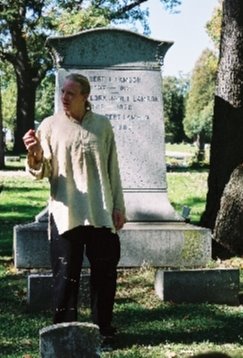 Continuing on, we next met Albert Lamson (played by Jason Valentine), a lieutenant with the 104th New York Infantry taken prisoner at a hospital near Gettysburg in July of 1863. Lamson spent ten months in Libby Prison, followed by a string of southern prisons, finally ending up at Camp Sorghum near Columbia, SC. In the autumn of 1864, he and another prisoner, Lt. E.E. Sill, affected their escape. Ordered to gather wood from the surrounding forest, they used forged paroles to slip past their captors during the day and hid in the woods until dark. They headed west through swamps, mountains and woods with dogs nipping at their trail. Subsisting on turnip root and tree bark, they used a firefly to light their compass as they followed a spur of the underground railroad.
By December they reached North Carolina, where they found aid among loyal mountaineers before recaptured by the Confederates. A Cherokee Indian was assigned to each, with orders to kill if either tried to escape, but being ever vigilant, the two once again managed to slip away. For three days they slept in the snow, eating bark and winterberries to stay alive, finally reaching the Union line at Loudon, TN—ironically about the same time Sherman liberated Camp Sorghum and set fire to Columbia. Asked later if months of enduring hardship were worth it, when rescue was so near, Lamson would only say that freedom was worth any price.
After the war, Albert Lamson went west to Wisconsin where he married Flora, daughter of James Gorham (another name familiar to Madisonians). They settled on a farm near the present-day Nakoma neighborhood, before moving to what is now Wingra Park. Pioneers in the strawberry industry, they delivered a variety of fruits and vegetables to town in a one-horse wagon.
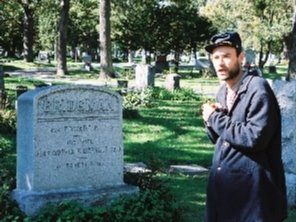 Edward Bridgman (portrayed by Ben Conklin) was among the forty “free-staters” led by John Brown who fought off some 300 pro-slavery border ruffians at the August 30, 1856 battle of Osawatomie, Kansas Territory. He was the second to last survivor of the uprising, and served three years as a member of the 37th Massachusetts. He came to Wisconsin in the 1870s, where he served as government storekeeper on the Menominee reservation at Keshena. He and his wife were homesteaders for many years before arriving in Madison in 1901 where he was deacon at Pilgrim Church and served as chaplain of the local GAR. A popular Memorial Day speaker, his wartime experiences were immortalized through the many letters he wrote home.
Thursday, October 05, 2006
Talking Spirits VIII: Fairchild, Ward and Harnden
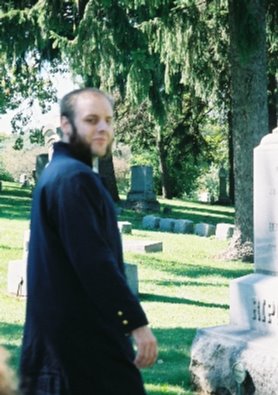 After taking our leave of Ebenezer Brigham, we continued up the hill a ways, where we encountered a couple of old friends, Lucius Fairchild and Andrew Ward (Cam Shimniok and Matt Kenyon), who served together in the 2nd. Wisconsin Infantry as part of the famed “Iron Brigade.” The Iron Brigade was a mostly Wisconsin company known for its reputation for its courage and tenacity in battles at Bull Run, Gainesville, Antietam (the Civil War’s bloodiest battle), and Gettysburg. The Iron Brigade suffered the most casualties of any brigade in the Civil War.
Fairchild enlisted in the army in 1861 in the Wisconsin volunteer infantry, rose through the ranks to colonel. During the first day's fighting at Gettysburg in 1863, Fairchild’s men fought fiercely against an advancing line of rebels, with 233 of his 302 men killed, wounded or reported missing, and Fairchild himself had his left elbow shattered by a bullet, and it was Fairchild’s good friend and army surgeon, Andrew Ward, who amputated his left arm. Fairchild was captured by the rebels when they took the town, but was left behind during their retreat.
Promoted to brigadier general before being mustered out of the service, Fairchild served as secretary of state of Wisconsin from 1864 to 1866. He became Wisconsin’s first three-term governor in 1866, after which he was appointed U.S. consul at Liverpool in 1871 and then consul general at Paris.
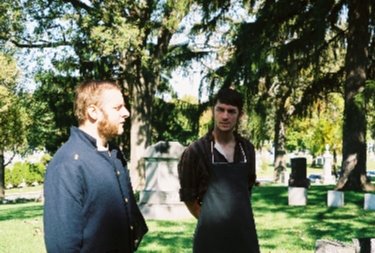 Andrew J. Ward served the 2nd Wisconsin for three years and saw to 900 wounded at The Wilderness in only a matter of days. His wife Eleanor accompanied him during those years and aided him in battle hospitals. She was said to be "cheerful and courageous" even in the harshest of conditions and loved by all who met her. Andrew Ward returned to Madison with the rank of lieutenant colonel, where he was a “wholesale and retail dealer in drugs and medicines” on King Street.
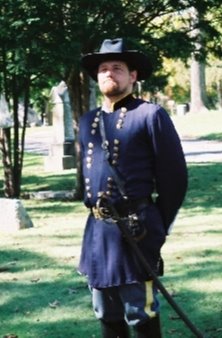 By far, the liveliest character we met on the tour was that of Henry Harnden. Descended of seafarers, Harnden was a world traveler and adventurer, sailing to the coast of Africa at age 18. By the age of 23 he had visited numerous islands in the Pacific and explored the entire west coast of South America. In 1850 he headed to California to try his hand at mining, before traveling to Wisconsin where he opened a sawmill.
Harnden joined the 1st Wisconsin Volunteer Cavalry in July 1861 and rose through the ranks to become lieutenant colonel. On March 13, 1865, he was brevetted to colonel and to brigadier general. It was about this time that the story he had to tell began. On May 6 of that year, Harnden received orders to lead a Wisconsin detachment of 150, their mission to capture Jefferson Davis. Portrayed by Tom Lodewyck, Harnden captivated the crowd in his convincing and animated telling of how he and his men tracked Jeff. Davis and, after a brief friendly-fire encounter with the 4th Michigan, finally captured the rebel at Irwinsville, GA on May 10.
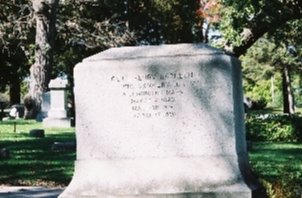 Harnden mustered out of the service in July 1865 and settled in Madison where he raised Jersey cattle, owned a grocery on State Street and served as trustee to the Soldiers’ Orphans Home (more on that later). He served one term in the State Assembly (1866), as was also U.S. Assessor (1867-1873), and U.S. Collector of Internal Revenue (1873-1883). He died of pneumonia at his home in 1900, survived by his widow and four children.
Due to controversies over the capture of Jefferson Davis, Harnden wrote a short book, The Capture of Jefferson Davis (1898), which can be read online here. It truly is a fascinating and daring tale, whether or not you are a Civil War buff (which, believe it or not, I am not--though I do find it an interestingperiod in history).
Tuesday, October 03, 2006
Talking Spirits VIII: Ebenezer Brigham
First, if you missed the posts on the 2005 Talking Spirits tour, you can read them at the following links. Part 1 might especially be of interest, since it relates a great deal of cemetery history which I won't go into again this year. A few of the actors from last year's tour returned for this one, including Liz Angle, Ben Conklin and Tom Lodewyck. Also of note, one of the stops that was a last minute cancellation on last year's tour (see Part 2) was included again this year.
Part 1: Intro
Part 2: The Tour Continues
Part 3: Confederate Rest & Soldiers Lot
~~~~~~~~~~~~~~~~~~~~~~~~~~~~~~~~~~~
Part 1: Intro
Part 2: The Tour Continues
Part 3: Confederate Rest & Soldiers Lot
~~~~~~~~~~~~~~~~~~~~~~~~~~~~~~~~~~~
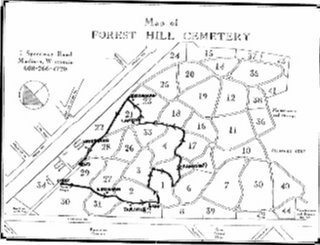
Map of this year's tour
One of my favorite fall events in Madison is the annual “Talking Spirits” tour through historic Forest Hill Cemetery. During the two-hour tour, visitors meet a half dozen “spirits” – some of Madison’s most prominent sons and daughters – and hear their fascinating stories. Presented by the Wisconsin Veterans Museum, the event focuses on a different conflict each year, with this year’s emphasis being on the Civil War – also known as the War Between the States. I've copied this year's map so that you can follow the path we took through the cemetery, beginning near number 34 and ending near number 29. Though we only traversed half the cemetery, it was a meandering route and not at all flat.
As is customary, the tour began at Catlin Chapel, where the director of the WVM shared information about the museum and cemetery, then introduced our guide and we were on our way.
We started towards the first stop on the tour, our guide pointing out some of the different aspects of cemetery architecture, as well as a few stones belonging to prominent Madisonians: the large silver sphere of Tenney, the tall and overly pretentious obelisk of Henry Vilas, the plot owned by the Shipman family – Stephen Shipman having been a great architect who built many of the early buildings in Madison and who literally helped rebuild Chicago after the Great Fire.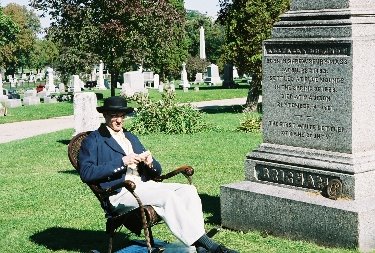 At last we came to the first spirit of this year’s tour, Ebenezer Brigham (portrayed by John Eichenlaub), who “politely” instructed us to move along up the road as he was “there first.” Silence, as he went back to his whittling, then realizing we were still there, he relented to tell us about himself. Brigham was indeed here first — or at least, he was the first permanent white settler of Dane County. He came west to St. Louis where lead was reported to be found, moved to Galena, IL, and then north to what is now Blue Mounds, where he struck the mother lode. Native Americans were also mining the hills, though their tools and methods were much more primitive, and left Brigham to his own. However, word soon spread of his bounty and miners quickly swarmed north.
Recognizing an opportunity when he saw one, Brigham opened a store for the prospectors, regularly traveling down to Galena or up to Green Bay for more supplies. It was during one of his supply trips up to Fort Winnebago that he camped on a beautiful isthmus nestled between two pristine lakes. So taken was he by the sunrise over the eastern lake the next morning that he later remarked it was at that moment he knew great city would one day be built there.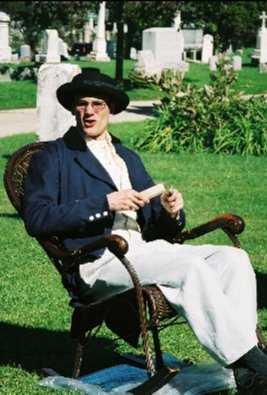 A year later he met a surveyor by the name of James Doty and told him of the narrow spit of land rising between the lakes. Doty traveled to the spot and was so taken with it that he purchased 12 acres for $1500 and named his new city after President James Madison. Both a street and a park bear the Madison name as well. Brigham served on the first Territorial Council and in 1836 pushed to make Madison the state capitol. He served until 1842, and later served a term in the assembly. He was a veteran of both the Red Bird uprising of 1827 and Black Hawk War of 1832. He died in 1861. Providing a panoramic view of the Wisconsin River Valley, Brigham County Park near Blue Mounds was named in his honor.
Monday, October 02, 2006
CowParade: Cow Boom


 Cow Boom
Location: Best Western InnTowner, corner of University and Highland
Artist: Kate Alt
Sponsor: Best Western InnTowner and the Highland Club
Yes! I finally got the last of my cows today. There were supposed to be 101 cows on display in the Madison area, but one was apparently never completed, and five of them are in Sun Prairie, which I have no way of getting to. Which left 95 cows in Madison and Fitchburg, and “Cow Boom” was the last one I needed. It is miles out University Avenue, away from all the other herds and stands alone at the Best Western. Between the hotel parking lot and high traffic volumn of this corner it was a bit difficult to get an uncluttered photo, but I tried my best. I love the reflection of the Capitol in the water below, and check out the fireworks inside one of the cow's ears.
This weekend was the annual “Talking Spirits” tour at historic Forest Hill Cemetery, and — being the intelligent woman I am (no comments from the gallery!) — I happened to think that Speedway Road was only a few blocks south of University and this final bovine might be within walking distance. Sure enough, upon consulting a map I found it was a mere three blocks north of the cemetery. I didn’t even have to travel east or west once I reached University, as the hotel is right on the corner of University and Highland — Highland being a part of the odd junction of Speedway, Regent, Highland and the entrance to Resurrection Cemetery. Resurrection is across the street from Forest Hill Cemetery. Weird, I know, having two large cemeteries adjacent to one another. Resurrection is the “Catholic” cemetery in Madison, whereas many different faiths are represented at Forest Hill.
Any way, we had a beautiful October day, and the tour was one of the most interesting to date. This year’s focus was on Madisonians who served during the Civil War — a couple of generals, a surgeon, a Union POW and a woman who tended Confeserate Rest for 30 years. Yes, I took notes and pictures, and even had the pics developed right after. The photos are now uploaded to the computer and I hope to start a write-up on the event starting Tuesday, so be sure to check back then!
Saturday, September 30, 2006
Talking Spirits VIII Cemetery Tour
Here's what I will be doing Sunday afternoon:
TALKING SPIRITS VIII
When: 10/1/2006, 12pm-4pm
Where:
Forest Hill Cemetery
1 Speedway Rd.
Madison, WI
"Founders, Fighters & Old Friends," Wisconsin Veterans Museum two-hour walking tours.
Civil War Heroes "Come Alive" at Forest Hill Cemetery
A POW who escaped from a Confederate prison, a Madison woman who tended Confederate soldiers' graves, and a soldier who assisted in the capture of Confederate president Jefferson Davis will all "come alive" at Forest Hill Cemetery on Sunday, October 1.
The Wisconsin Veterans Museum will offer two-hour living history tours of the Cemetery leaving every 15 minutes, beginning at Noon and ending no later than 4 p.m. Professional actors portray seven different Civil War-era citizens buried at the cemetery. Tickets are $5 for adults and $2 for children, and can be purchased the day of the tour.
The 8th annual tour is themed: "Founders, Fighters and Old Friends." More than 1,000 people participate in the tour each year, and discover the rich history found at Forest Hill. Local playwright John Sable creates the scripts for the event. The tour is supported by the Dane County Cultural Affairs Commission with additional funds from the Overture Foundation.
Friday, September 29, 2006
CowParade: The Road Home


 The Road Home
Location: In front of the Wisconsin Historical Society, UW Campus
Artist: Kirill Negoda
Sponsor: Capital Newspapers
Wednesday, September 27, 2006
CowParade: Animal Magnetism

 Animal Magnetism
Location: Martin Luther King Jr. Blvd
Artist: Jenny Steinman Heyden
Sponsor: Wisconsin Milk Marketing Board
Sadly, this one has seen extensive damage since I took this photo. The dog was ripped off the back, and other animals were also damaged — which means a lot of work for the artist to get this one ready for the auction in November. I did take pics of the damaged cow while downtown for The Taste of Madison earlier this month, but have yet to upload them to the computer.
Monday, September 25, 2006
CowParade: Holstein Parade


 Holstein Parade
Location: Mifflin Street on the Capitol Square
Artist: Mary Heinze
Sponsor: Roundy’s / Kemps
Friday, September 22, 2006
CowParade: Chloe


 Chloe
Location: Upper State Street
Artist: Elaine Meszaros
Sponsor: Sponsor: Wisconsin Milk Marketing Board
A pretty one located near the new Overture Center on upper State Street. Don’t ask me why the cow with all the ice cream cones is called “Poppy” and this one with all the poppies on it is called Chloe. What can I say, I’m not one of the artists. According to the artist’s blog, it took about 200 hours to paint Chloe. That’s one heck of a time commitment! To put that into perspective, there are 168 hours in one week. If you want to see some cool pics of Chloe in progress, check out Elaine Meszaros’ blog!
Thursday, September 21, 2006
CowParade: Poppy

 Poppy
Location: Upper State Street
Artist: Kelly Parks-Snider
Sponsor: Chocolate Shoppe Ice Cream Co, Inc.
I think the Chocolate Shoppe’s website says it best….
Nutritional information: Don’t even ask. This is the best ice cream made in Wisconsin, and it tastes so good because it has gobs of rich Wisconsin cream, tons of real ingredients for boatloads of luscious flavors. That means it’s not low-fat, low-calorie or low-anything, and that’s why everyone loves it. You want nutrition, eat carrots.
~*~*~*~*~*~*~*~*~*~
So...what's YOUR favorite flavor of ice cream? My basic stand-by is mint chip, but almost anything chocolate without nuts (or coffee flavoring) will do. Like chocolate raspberry truffle or peanut butter cup. Mmm.... I see on their website that they also have a flavor called cake batter fudge. How come they never have that one when I'm there?!
Wednesday, September 20, 2006
CowParade: Rise and Shine

 Rise and Shine
Location: Mifflin Street on the Capitol Square
Artist: Jennifer Martens
Sponsor: Land O’Lakes
This is another one of those cows that remind me of works by Van Gogh. Love the swirling brushstrokes, especially those of the red and gold sun shining on her back. Not to mention those big blue eyes...
Tuesday, September 19, 2006
Miss Turquoise Tillie

 Miss Turquoise Tillie
Location: North Pinckney Street (Capitol Square)
Artist: Bonnie Mohr
Sponsor: Agri-View
Isn’t she perty? This was taken back in mid-July, during Art Fair on the Square – hence all the tents and people in the background.
Monday, September 18, 2006
Leaves Awash
The top card here was created for last week's sketch challenge at SCS -- each week you are given a sketch and you can use whatever colors, stamps or embellishments you wish for your creation, so long as you stay true to the sketch layout. Cardstock is Pale Plum, Perfect plum, and white. I used the houndstooth and linen background stamps, and the Leaves Awash jumbo wheel from Stampin' Up. The autumn sentiment is from Savvy Stamps. Raffia is the only embellishment used, and I was really pleased with how this one turned out.
The bottom two were among those made Sunday afternoon. I used the last two strips of the Leaves Awash OSW I did some time ago, and Lovely Lilac cardstock, with scraps of other colors for the sentiment and matting. The bottom two also used the deckle stamp from Itty Bitty Backgrounds.


The bottom two were among those made Sunday afternoon. I used the last two strips of the Leaves Awash OSW I did some time ago, and Lovely Lilac cardstock, with scraps of other colors for the sentiment and matting. The bottom two also used the deckle stamp from Itty Bitty Backgrounds.


Subscribe to:
Posts (Atom)