Last week I shared photos from the
"Blooming Butterflies" exhibit at
Olbrich Botanical Gardens, which is held every summer in the Bolz Conservatory. As promised, here are a few pics of some of the plant life you'll find inside.
The Bolz Conservatory opened in November 1991 and has seen more than 1.5 million visitors since then. Many of the tropical and sub-tropical plants grown and conserved here are endangered in the wild. There are more than 650 different plants, as well as birds, geckos and tree toads that help control insect infestations.
The glass pyramid measures 100 by 100 feet, and is 50 feet tall at its center. The temperature is kept at a constant 65 to 80 degrees, but may warm up to 95F on hot summer days. It is kept above 60 percent humidity year-round, so is especially nice to visit during those cold, dry winter months.
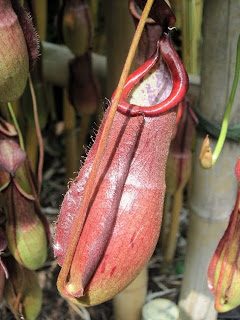 Pitcher Plant
 These are one of my favorite plants in the Bolz Conservatory. While they may be cute, they are also carniverous plants that eat insects. Also known as "Monkey Cups," they are native to India, South East Asia, Madagascar and Australia.
 Oranges
 are one of many food plants that can be found here. You might also see cacao, coffee, banana, vanilla and papaya.
 Hibiscus
 There are several hundred species of hibiscus, and they are found world-round in warm-temperate, tropical and subtropical regions.
 Hanging Lobster Claw
 Another cool tropical plant. Native to Central and South America.
 Moth Orchid
 There are several different species of orchids, including these pretty purple ones.
 Fuschia
 There are around 110 different species, most of which are native to South America, but they are also found in Central and North America, and from New Zealand to Tahiti. While most are purple or magenta in color, they can also be orange or white (or any combination thereof).
 Fishtail Palm
 Native to Southeast Asia and India, this tree can be grown in some southern states. It is "cold hardy" down to 15F and requires shade to partial shade. It requires a lot of water with good drainage.
 Anthurium or Flamingo Lily
 Also called Boy Flower (for obvious reasons, snicker). There are some 600-800 species of these, and maybe even up to 1000. Primarily found in wet tropical mountain forest of Central America and South America.
 Chenille Plant
 Also called Philippines Medusa, red hot cat's tail and fox tail. Originally native to Oceana, it can now be found in parts of the US and Mexico. While it can be grown as a houseplant, it is poisonous to animals if ingested. And yes, it is as fuzzy soft as it looks.
 Calathea
 Also known as prayer plants, calatheas are native to the tropical Americas. In some areas the large leaves are used in handicrafts (such as containers) or to wrap fish for transport.

No idea what this one is--I couldn't find the placard naming it. It was probably hiding somewhere under all the foliage. I think it might be a type of orchid.
 Phalaenopsis, or Bamboo Baby Orchid


