Showing posts with label Cemetery. Show all posts

Thursday, February 23, 2017

Thursday Thirteen 449: Mortsafes


If you saw this week’s Tuesday Teaser, you know that mortsafes played a significant role in The Sinner by Amanda Stevens. I had heard of these contraptions previously, but reading this book prompted me to learn more about them.

01. Mortsafes were designed to protect graves from disturbance, particularly from body snatchers, who provided anatomy schools with fresh corpses from the early 1700’s.

02. It was necessary for medical students to learn anatomy by attending dissections of human subjects, but there was a low allowance of dead bodies allowed by the government—mostly criminals or the homeless who died with no known relatives.

03. Authorities turned a blind eye to grave robbing, as it advanced medical knowledge, and tried to keep publicity to a minimum so people would not know what was happening. Lonely country graveyards were particularly vulnerable. Grave-snatchers were paid to dig up and transport bodies—sometimes even across the sea.

04. Revelations led to public outrage, especially in Scotland, where the dead were revered, and where there was a literal belief in the Resurrection. It was believed by many that the dead could not rise in an incomplete state.

05. Knowledge of grave robbers led to finding ways of protecting one’s friends and relatives. The poor dug heather, branches, and rocks into new graves to make it more difficult to dig them up, and also set people to watch graves at night, when such activity was most likely to occur. Watch societies formed, with one in Glasgow registering 2,000 members.

06. The rich, however, could afford more extravagant measures such as vaults, table tombstones, mausoleums and iron cages around graves.

07. The mortsafe was invented around 1816, and were heavy iron or iron-and-stone cages that fit around graves.

08. Mortsafes were a complex design of heavy iron rods and plates that were padlocked together, and fit over the coffin. They could only be removed by two people with keys, and were kept in place for at least six weeks, by which time they deemed the body to be adequately decayed that it was no longer of use to medical schools.

09. Churches sometimes bought a number of mortsafes which were then rented to parishioners.

10. Similarly, watch societies would also buy several of the contraptions with membership dues, and hire them out to non-members.

11. Examples of mortsafes have been found close to all Scottish medical schools, as have watch towers used to watch graveyards for any nefarious activity.

12. Vaults—or morthouses—were built both above and partially below ground to protect the dead. A unique one in Aberdeenshire consists of a circular building with a thick studded wooden door and an inner iron door. Inside there is a turntable to accommodate seven coffins. A coffin would be moved round as further ones were added and by the time it reappeared the body would be of no use to the dissectionists.

13. There are only two known mortsafes in the United States, in Catawissa, Pennsylvania. This pair of mortsafes is more decorative than those traditionally found in Scotland and parts of Great Britain.


LINKING TO: Thursday Thirteen


Thursday, October 29, 2015

Thursday Thirteen 394: Autumn Cemetery

More photos from Forest Hill Cemetery, Madison -- I believe this array shows the age and beauty of the cemetery, which predates the Civil War. You'll note that many are time-worn or broken. There is much debate among taphophiles as to whether older and/or damaged grave markers should be repaired or replaced. In some instances, descendants may opt to repair or replace broken monuments, sometimes leaving the old one alongside the new.


This is one of my favorite photos taken during my visit last year.


WISHING EVERYONE A HAPPY AND SAFE HALLOWEEN!


LINKING TO: Thursday Thirteen


Thursday, October 22, 2015

Thursday Thirteen 393: Graveyard Symbolism

Last week I shared some of the graves of prominent Madisonians buried at Forest Hill Cemetery. This week I thought I would share some of the common symbols found in cemetery art/grave markers. As with last week, these were all taken by me last fall at Forest Hill Cemetery.


A scroll can symbolize the scriptures, honor and commemoration,
or serve as a symbol of life and time. If both ends are rolled
up as they are here, it usually indicates a life unfolding like a scroll. 


Lambs are the saddest of images to find in a cemetery.
They are a symbol of innocence and usually denote
the grave of a young child. 


Draped Column: Columns symbolize mortality or a noble
 life. If the column is draped, it means a life cut short. 

Ivy symbolizes faithfulness, memory and undying friendship. 


Books denote faith and wisdom. This is actually a family
marker, on my paternal grandmother’s side. Due to time
and lichens, it is difficult to tell if there was a symbol or
something written on the book cover. 


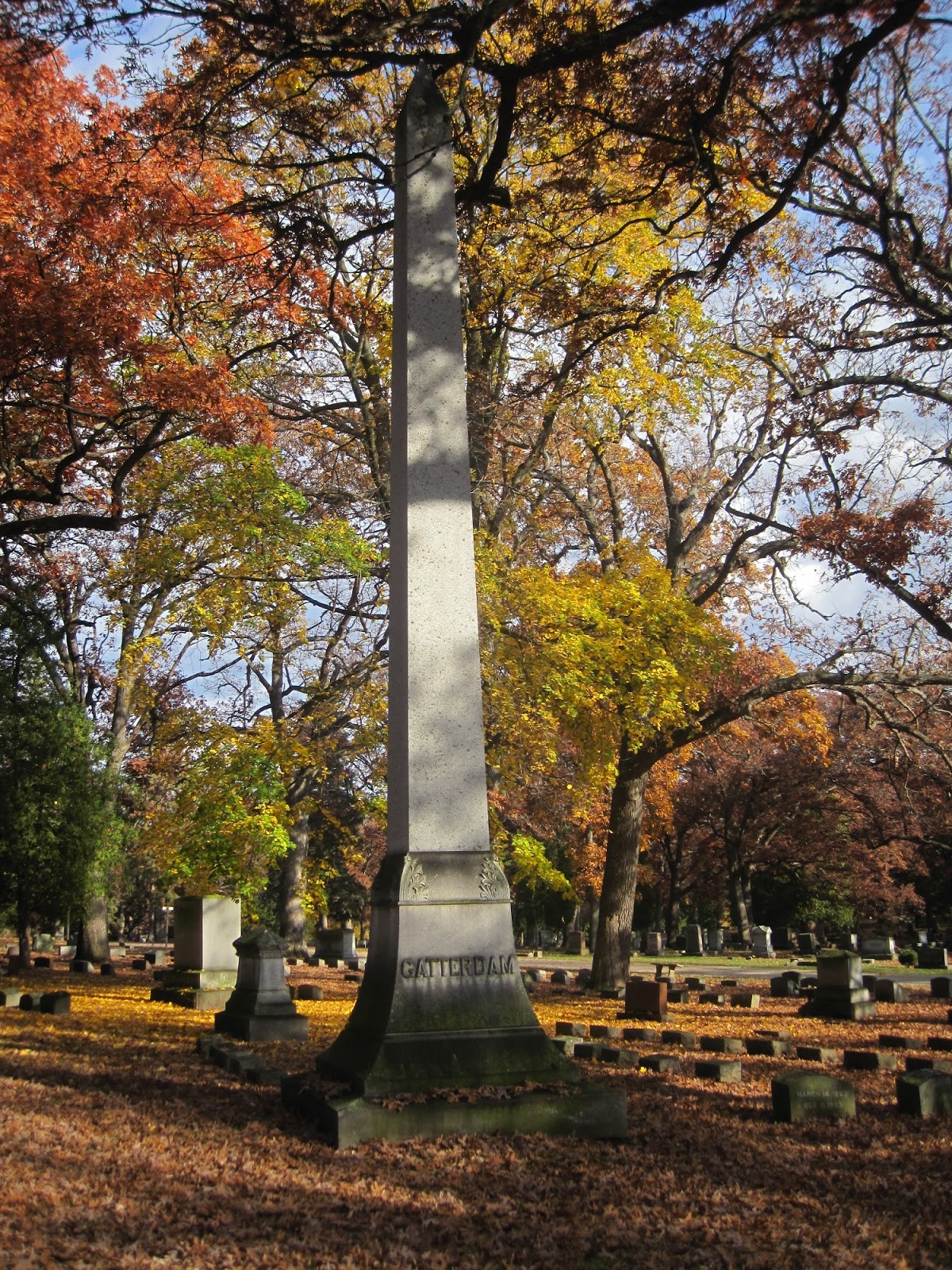
Obelisks are one of the more popular shapes of grave markers 
from the late 1800's. Some may be only a few feet tall, while
 others soar towards the sky. An obelisk can symbolize
foundation or fatherhood, as well as rebirth, and are
often found in family plots, where the names of different
family members buried together may be inscribed on
different sides of the obelisk.


Here we have an open book, symbolizing the Book of Life. 
You’ll note also the Star of David for “divine protection,” 
and indicating a Jewish grave. Many of the markers in 
the Jewish section have Hebrew writing as well — 
some only a few words, while others are all in Hebrew.


Orbs also come in many different sizes, from a small sphere 
atop a grave marker, to a large sphere  that makes up the majority
of the marker as with the Tenney monument. An orb symbolizes
the soul or celestial body and the reward of resurrection. 


An arch symbolizes the passage to heaven. You'll
note also the urn on top, as with another photo below.  

Tree trunks or stumps often denote the graves of Woodmen of the
World members, but can also indicate a life cut short, as is the
case here. Annie and Lillie Ramsey both died young, at ages
two and five respectively. You’ll note also the scroll, or life unfolding. 

Oak leaves stand for longevity, 
meaning the deceased led a long life.  


Urns are also popular symbols found on graves,
 denoting the soul. It can be an actual urn, such as that 
of the Bunn grave pictured here, or etched 
onto the marker itself. You'll note also the columns. 


Clasped Hands indicate unity or farewell to an earthly
existence. They can also indicate that spouses have
been reunited in death.


LINKING TO: Thursday Thirteen


Thursday, October 15, 2015

Thursday Thirteen 392: Who's Who at Forest Hill Cemetery

In the autumn of 2014, I spent an afternoon at historic Forest Hill Cemetery here in Madison, but never got round to sharing some of the 200+ photos taken that day. I figured this October was a good time to finally do so.

Forest Hill predates the Civil War, and among its many features includes Soldiers Lot, where Union troops from the Civil War are buried, and Soldier's Rest, the northern-most Confederate Graveyard. You'll also see many familiar names while wandering amongst the graves. With many prominent and old families buried here, it is a veritable "who's who" of Madison. Here are a few of the more familiar names you'll find at Forest Hill.


Truax Field is a US Air National Guard filed near the Dane
County Regional Airport on Madison's north side. It was named
for Wisconsin-native Lieutenant Thomas L. Truax, who was
killed in a P-40 training accident in November 1941.


Named for Frank W. Hoyt, Hoyt Park is a former quarry and quiet
 little park on Madison's west side. I blogged about it here in 2007. 


John Myers Olin was the father of the Madison parks system. There were only 3-1/2
acres of parkland when he started, and 269 acres when he died. Olin Park bears his name.


Henry Turvill was a local farmer who sold part of his land for a site
where a spa/resort called the Water Cure was built. The site went
bankrupt after two years, and the property eventually returned to the
Turvills. An "e" was added to the end of the name around 1905. The
land came to the city in 1967, and was officially designated a
conservation park in 1998. Read more here.


James Doty was a member of the US House of Representatives, the
second governor of Wisconsin and fifth governor of Utah Territory.
He is responsible for Madison being chosen the state capitol, a city
that only existed on paper at the time. A street and parking ramp
 currently bear his name.


The memorial for Daniel Kent Tenney is one of the more ostentatious
monuments found at Forest Hill. Tenney was an attorney in Madison and
 Chicago who purchased land for a city park that now bears his name -- 
and is one of the best places to ice skate in winter, and a popular beach 
and place to fish in summer. The only lochs in the city are at this park.


Breese J Stevens was a Madison Mayor in the late 1800's, and was also
an entrepreneur, UW regent, and curator of the Wisconsin Historical Society.
Breese Stevens Field is named for him, which is on the National Register
of Historic Places and Wisconsin State Register of Historic Places. 


William H. Hamilton was a Lt. Colonel with the 36th Wisconsin
Volunteer Infantry during the Civil War, and later served as
Sergeant-at-Arms for the state senate. Hamilton Street bears his name.


The Fairchilds were a prominent family in the 1800's. Jairus Fairchild
was Madison's first mayor and father of Lucius and Cassius.
Lucius served in the Civil War, and was Wisconsin's first 3-term governor.
He also led the efforts to build the Wisconsin Historical Society. His brother
Cassius was a Colonel in the Civil War, an alderman, and a legislator.
He died ten days after he was married, when a war wound reopened while
serving as pall-bearer at a friend's funeral. His wife later remarried. 


John Lathrop was an educator and first president of the University
of Wisconsin. There is a street near campus named for him. The
columns of this monument are for his sons, and represents lives cut short.
His son Leopold died in Madison, and his son John in Mexico.


The Goodmen brothers were prominent jewelers and local philanthropists.
There is a baseball diamond, community center and a city pool name
after them. You can read more about them here


Charles H. Mills was a music professor of  the UW who revitalized
the program and created a four-year music degree. He also promoted
the Wisconsin Music Clinic, a summer program for which high
school students earn college credits, and designed pipe organs for
the Masonic Temple, Music Hall and two churches in the area.
There is a street and UW Music library named for him. 


I believe this obelisk for Vilas is the tallest and heaviest monument
at Forest Hill Cemetery. They had to lay train tracks to the cemetery in
order to transport it there. The Henry Vilas Zoo is named for the son of 
William F. and Anna M. Vilas, who donated 63-acres for the park in 1904.


LINKING TO: Thursday Thirteen


Saturday, November 08, 2014

Friday, October 03, 2008

Talking Spirits X

What my plans for the weekend include...

Talking Spirits X: Forest Hill Cemetery Tour
October 1 - 5, 2008
Public tours: Sunday, October 5, 2008 – Noon to 4pm
$5/adult, $2/child; tours leave every 15 minutes

Join us for the tenth annual Talking Spirits: Forest Hill Cemetery Tour, held at beautiful Forest Hill Cemetery, 1 Speedway Road, in Madison. This award-winning living history program illuminates the lives of many prominent—and lesser known—figures in Wisconsin history. Focusing on the contributions of Wisconsin’s Civil War veterans as well as those individuals who supported the war effort at home and elsewhere, local actors and actresses don period dress, giving visitors the once-in-a-lifetime experience of meeting these characters on the cemetery grounds. Included along with six vignettes will be informative discussions of the cemetery’s rich history and gravestone art.

This year’s characters:
William Noland, prominent African-American resident of Madison
Frank Oakley and wife, officer, 7th Wisconsin Infantry
Emilie Quiner, Civil War nurse and Madison schoolteacher
John Coleridge Pradt, 3rd Wisconsin cavalry, wounded at Baxter Springs
Stephen Shipman, officer, 1st Wisconsin Cavalry; architect, second Capitol
George Washington Spears, Confederate solider killed at Camp Randall by guard


Friday, October 12, 2007

Forest Hill Cemetery

A few more pictures from Forest Hill....
The pillow atop the Herrick-Doyon marker means "Rest in peace."


Beverly Jefferson was the grandson of Thomas Jefferson and Sally Hemmings. His father, Eston, became a free man when his mother died and, by law of manumission (the formal act of freeing from slavery), was required to leave Virginia. Eston and brothers Madison and Thomas settled in Ohio in 1826, and in 1852 he and his wife Julia moved to Madison. It was at that time that they took the surname Jefferson. Beverly was a hotel keeper, owned a carriage line, and also served in the 1st Wisconsin Infantry.


The only wooden marker at Forest Hill, dating back to the cemetery's beginning. There are no records indicating who is buried here, but we were told that it may be that of Millie Kearns. This is not the only "unknown" lying at rest in Forest Hill. There are 339 unknown Madisonians listed in cemetery records, most of whom were buried in the village cemetery before they were moved here. Wooden markers were common in the early village days, particularly by the poor who could not afford permanent markers.


Thursday, October 11, 2007

Thursday Thirteen #29: Cemeteries


Though many find them creepy and morbid, I love cemeteries -- the older the better. I'm not saying I'd take a leisurely stroll through one on a dark and stormy night, but during the day they can be a peaceful communion with our past, whispering stories long forgotten. In keeping with the cemetery theme this week, here are thirteen cemeteries I've visited.

1. Père-Lachaise (Paris, France) ~ Visited during spring break my senior year in high school. I wish we'd had more time to wander those ancient paths. I remember passing markers for Hugo, Collette and James Morrison, but not many others. Must return some day!

2. Forest Hill Cemetery (Madison, Wisconsin) ~ Dating back to 1857, Forest Hill is a virtual "who's who" of Madison with many leaders in geovernment and other fields buried here, including one of my high school English teachers. There is also a paternal aunt who died of polio at age 9.

3. Resurrection Cemetery (Madison, Wisconsin) ~ It may not be quite as picturesque as Forest Hill, but there are a number of interesting Madisonians buried here as well. Located across from Forest Hill, it is the city's "Catholic" cemetery.

4. Roselawn Memorial Park (Madison, Wisconsin) ~ This one I've only been to once or twice, as it is more difficult for me to get to. Must make an effort one of these days to track down my paternal grandfather.

5. Mt. Cavalry (Dubuque, Iowa) ~ Maternal grandparents are buried here. I don't recall much about it as it's been a couple decades since I was there. I remember a pretty little chapel and, being as it was January, lots of snow and cold.

6. Mount Moriah Cemetery (Deadwood, SD) ~ The original Boot Hill where Calamity Jane and Wild Bill are buried.

7. Lafayette Cemetery #1 (New Orleans) ~ Can you visit New Orleans without viewing at least one cemetery? I only wish we had taken one of the cemetery tours and had taken more pictures. Next time... *wink*

8. Arlington National Cemetery (Alexandria, VA) ~ Sobering, but definitely a site worth visiting in the Washington, D.C. area. Though it was interesting to see the graves of the Kennedy family and mast of the USS Main, and the Tomb of the Unknowns emotional, what impacted us more was the monument to the Space Shuttle Challenger crew, which exploded in 1986 when we were still in high school. I think it's a matter of remembering where you were when it happened, much as the Kennedy assassination is for our parents.

9. Gettysburg National Cemetery (Gettysburg, PA) ~ A solemn site to visit, but well worthwhile. There are monuments dedicated to various regiments who fought and perished here scattered throughout the battlefields. During our first visit we did not find any for Wisconsin, but found all but one the second time there, including one for the famed Iron Brigade.

10. Fort Mackinac Post Cemetery (Mackinac Island, MI) ~ A pretty little historic cemetery.

11. St. John's Church (Richmond, VA) ~ A lovely old graveyard I would have enjoyed exploring at greater length. The church was built in 1741 and buriels continued into the 1820s. Among those buried here are George Wythe (signer of the Declaration), Elizabeth Arnold Poe (Edgar's mother), James Mercer, and many veterans of the American Revolution and War of 1812.

12. St. Mary's Cemetery (Old Town Alexandria, VA) ~ While visiting a friend in Alex one year, we all went on a ghost tour, which ended at this quaint little church cemetery.

13. La Belle Cemetery (Oconomowoc, WI) ~ I wish I could say my visits to this one were ones I wanted to remember, but who wants to remember burying a friend who was taken far too young (ten yrs ago this December)? Still, it is a pretty cemetery, and she has a beautiful view from her hilltop. TFJ, Jenni.

And two I'd like to visit:

14. Mount Auburn Cemetery (Boston, MA) ~ Dedicated in 1831, it was the first of America's rural, or garden, cemeteries and is the one Forest Hill Cemetery is modeled after. I saw this one featured on a PBS special about famous cemeteries in the US in 2005 and it does intrigue me. History and horticulture coexist here, and famous graves include those of Henry Wadsworth Longfellow, Oliver Wendell Holmes, Julia Ward Howe, Charles Bulfinch, James Russell Lowell, Winslow Homer, Margaret Fuller, and abolitionist Charles Sumner.

15. Oakland Cemetery (Atlanta, GA) ~ Another one heard about in the PBS cemetery special. Notable graves include that of author Margeret Mitchell.


Links to other Thursday Thirteens!

Tempest * Lia Morgan * Tara Nichols * Shelley Munro * Babe King * Gina Ardito * Jennifer Shirk * Darla * Adelle Laudan * Savannah Chase * Morgan St. John * JAC * Debbie Mumford * Paige Tyler * DD Mills * Seeley Deborn * Kaige

(Leave your link in comments, I’ll add you here!)


Get the Thursday Thirteen code here!

The purpose of the meme is to get to know everyone who participates a little bit better every Thursday. Visiting fellow Thirteeners is encouraged! If you participate, leave the link to your Thirteen in others comments. It’s easy, and fun! Be sure to update your Thirteen with links that are left for you, as well! I will link to everyone who participates and leaves a link to their 13 things. Trackbacks, pings, comment links accepted!


Tuesday, October 09, 2007

Talking Spirits IX, Part 3

Continuing on through the cemetery via a rather circuitous route, we next arrived at the marker for Laura Noland, daughter of William H. Noland. According to promo about the tour, William was to be one of this year's "spirits," but was not actually included, except for this brief stop at his daughter's grave. Noland and his wife A.M. are also buried in this section, in unmarked graves.

Noland and his family came to Madison in the 1850's, the first African American family to settle here permanently. Sons Charles and Frank were the first African American children born to the town, and one of his sons is believed to be the first AA graduate of the University.

Known as "professor" to many citizens of Madison, Noland worked as a baker, barber, clerk and bookkeeper in the land office, and operated a dying and scouring business at the corner of Main and Fairchild. In 1957, William B. Jarvis nominated Noland as notary public, but the appointment was refused by Secretary of State David W. James, on the grounds that no one would go to or trust a negro notary public.

In 1861, Noland wrote to Governor Randall, asking if he would accept a negro company on equal terms with whites. Randall refused. In 1866 his name was placed on the democratic ballot for mayor as a joke, against his wishes. He was defeated 691-306 by Elisha Keyes.

A short distance further along our path we encountered another Civil War officer, General Theodore Read, portrayed by Brian Belz. Read never actually lived in Madison himself, his father having moved the family here during the war. The Civil War began the day after Read's 25th birthday, and he quickly rose from private to general. Wounded in the spring of 1863 at Chancellorsville, he was brought back to Madison to recuperate and was back with the army three months later. He was wounded again at Cold Harbor in May 1864 and promoted to major soon after. The following autumn he was promoted yet again, to brevet brigadier general. His greatest feat was to be his last.

On April 6, 1865, Colonel Francis Washburn was sent to High Bridge, VA to take control of a bridge and effectively end Lee's retreat west from Petersburg. Hearing that Confederate General Thomas Rosser had learned of the plan and was in pursuit of Washburn's party with 1200 men, General Ord sent Read to warn his men and take control. He arrived at High Bridge to find the men holding a fence in a small strip of woods above the bridge. Weighing the uneven odds--his 500 men against 6,000--Read nonetheless led his men in an attack against Rosser's cavalry. All Union officers, including General Read, were killed, and those men not killed were wounded and captured. Read was the second to last General killed during the Civil War.

Considering his demise, one might think the Battle of High Bridge an inconsequential failure but, in fact, Read's gallantry actually brought about a quick end to the Civil War. Upon hearing of Read's troops and the battle fought, Lee believed General Grant had some how gotten ahead of him. Halting his troops, Lee entrenched--a delay which allowed Sheridan's cavalry and the 6th Corps to catch up to him, capturing 7,000 Confederate troops. Lee surrendered to Grant a mere three days after the Battle of High Bridge.

Theodore Read was borne back to Madison for burial, where he lay in state in the assembly chamber at the Capitol. The Capitol was not used again for a funeral until that of Lucius Fairchild thirty-one years later.