Showing posts with label Civil War. Show all posts

Friday, October 15, 2010

Talking Spirits XII


Monday I promised there would be more pictures from last Sunday's "Talking Spirits" tour. I had planned to get pictures uploaded and processed for this week's Thursday Thirteen, but between one thing and another...it didn't happen.

This was the twelfth year for this annual event, held at Forest Hill Cemetery here in Madison. Forest Hill dates back to 1858 and was laid out as a pleasure park. Families once journeyed here on weekend afternoons for picnics, up until around WWII. With it's hundreds of shade trees and winding paths, it is still a pleasant and quiet place to walk.

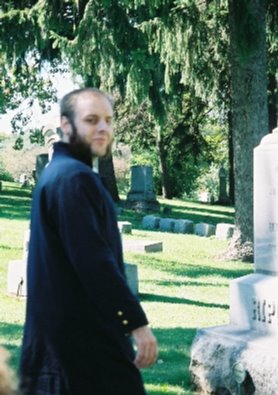
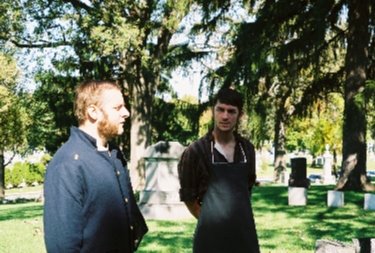
Talking Spirits is a "living history" tour, in which actors portray former citizens of Madison who served their country in some capacity, or were affected by war in some way. Though the Civil War has been featured most often, there have also been tours focused on WWI, WWII, and there was even one year that featured a cast spanning the Civil War to Vietnam.

Visitors are guided through Forest Hill Cemetery where they learn about the cemetery's history and about some of the graves and people buried there. Along the 90-min to 2-hour tour, there are five or six stops where visitors "meet" some of those who lived--and served.

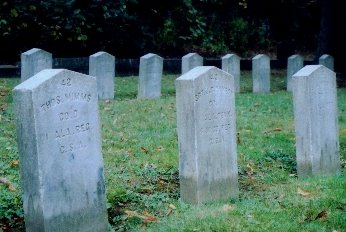
Within the grounds of Forest Hill are two Civil War graveyards, Soldiers Lot (where Union troops were laid to rest) and Confederate Rest (where POWs from Camp Randall were buried). Confederate Rest is the northern-most Confederate graveyard in the US.


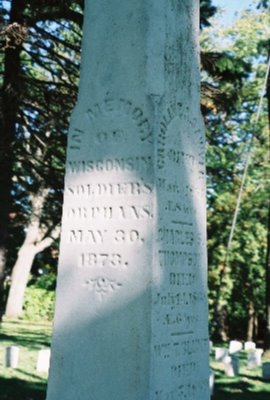
The tour began with a short introduction in Catlin Chapel before moving across the road to Soldiers Lot. This is where many local troops killed during the Civil War were buried, including about a half dozen unknown soldiers. There are also eight children buried here, orphans from the Soldiers' Orphans Home, founded by Cordelia Harvey. We "met" two of these children on this year's tour, William Blount and Emma Billow. Emma suffered a long, lingering illness, while William was taken ill quite suddenly one day and died before the next morning (although they did not say, my guess would be polio).


Atlas Brewster as William Blount and Destiny Sabljak as Emma Billows. Sabljak's father, John Sable, writes the scripts for the annual tours. Both youngsters were on last year's tour as well.


A teddy bear leans against the grave of Emma Billows.


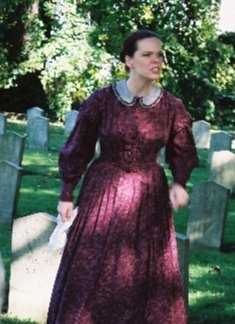
Unknown actress as Alice Whiting Waterman (I did not get a program this year as they ran out early), instructs vistiors in the history of Confederate Rest and how she came to care for the neglected graveyard. You can read more about her in this post from 2006.


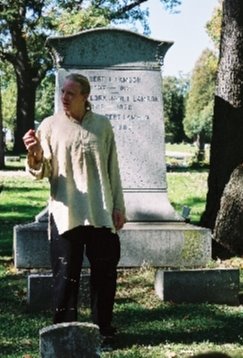
Lt. Alfred Lamson was captured at Gettysburg and spent ten months in Libby Prison, before making a daring escape. After months on the run, he was again taken prisoner, but managed to escape once more. You can read more about him in this post from 2006. After the war, he and his wife moved to Madison, where they grew strawberries and other produce. I think the actor here is Brian Belz, who has participated in previous tours.


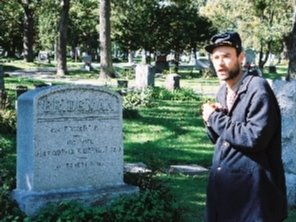
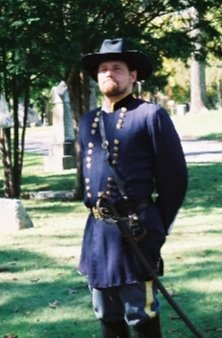
Tom Lodewyck reprising his role as Lieutenant Colonel Henry Harnden, another favorite character featured during the 2006 tour. You can read more about his exciting capture of Jefferson Davis here.


As you can see, Lodewyck is an exceptional actor and storyteller who really gets into his role.


The final vignette of the day featured Col. Cassius Fairchild and wife Mary. These two characters were previously featured during the 2007 tour, and I think they were portrayed by the same actors.

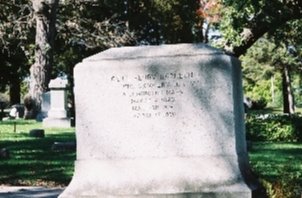
This scene is set after the war, when a wound Fairchild received during the Battle of Shiloh was fatally reopened. He died just ten days after he and Mary were married--talk about a short honeymoon!


I hope you enjoyed coming along on this year's Talking Spirits tour with me.


(ETA: Thanks to John Sabljak for letting em know that the actress who portrayed Alice Waterman is Jennifer Poppy.)


Friday, October 03, 2008

Talking Spirits X

What my plans for the weekend include...

Talking Spirits X: Forest Hill Cemetery Tour
October 1 - 5, 2008
Public tours: Sunday, October 5, 2008 – Noon to 4pm
$5/adult, $2/child; tours leave every 15 minutes

Join us for the tenth annual Talking Spirits: Forest Hill Cemetery Tour, held at beautiful Forest Hill Cemetery, 1 Speedway Road, in Madison. This award-winning living history program illuminates the lives of many prominent—and lesser known—figures in Wisconsin history. Focusing on the contributions of Wisconsin’s Civil War veterans as well as those individuals who supported the war effort at home and elsewhere, local actors and actresses don period dress, giving visitors the once-in-a-lifetime experience of meeting these characters on the cemetery grounds. Included along with six vignettes will be informative discussions of the cemetery’s rich history and gravestone art.

This year’s characters:
William Noland, prominent African-American resident of Madison
Frank Oakley and wife, officer, 7th Wisconsin Infantry
Emilie Quiner, Civil War nurse and Madison schoolteacher
John Coleridge Pradt, 3rd Wisconsin cavalry, wounded at Baxter Springs
Stephen Shipman, officer, 1st Wisconsin Cavalry; architect, second Capitol
George Washington Spears, Confederate solider killed at Camp Randall by guard


Wednesday, October 10, 2007

Talking Spirits IX, Part 4

During any war, those serving on the home front are equally as important as those fighting on the front lines. Not only are they the ones who keep homes, families and businesses going, they also provided medical, spiritual, and economic support to the soldiers. Harriet Grannis Morris (Lauren Peterson) was one such woman. Her husband William was a lawyer and the son of Lewis Morris, signer of the Declaration of Independence.

Mrs. Morris was a member of the Women's Aid Society during the Civil War. The Women's Aid Society raised money for medicines, nurses, and medical inspectors to improve sanitary conditions among the soldiers. Along with her work in Madison at the Harvey Hospital and with POWs at Camp Randall (articles here and here), Harriet Morris also wrote numerous letters to the boys from home, sending them care packages of shirts, woolen socks, and blankets. For some, these items could mean the difference between life and death during a winter campaign. Many of those who received her letters and gifts wrote back to thank her, such as the soldier portrayed here by Jason Valentine.

The last individual met on our tour was young Bascom B. Clarke (Seb Harris), who spoke of his experience as a young boy living in the south during the Civil War, and how he came to reside in the north. His is a true "rags to riches" story.

The family had been headed to Texas with two mule wagons in 1857 when they decided to settle in Mt. Adams, Arkansas. In 1963, the town fell victim to malaria. Completely surrounded by Union troops, Clarke's father managed to slip across enemy lines to another town for quinine, but not without cost. Though he saved most of the town, he himself contracted malaria and died. The following year, Bascom's mother passed away as well. The older children scattered across the south, while 12-yr old Bascom was taken in by a farmer, Mr. Smith, who had eight children of his own whom he abused regularly.

For months Bascom endured the abuse. As the area became more dangerous to live in, Smith convinced passing Union troops that they were Northern sympathizers trapped in the South, and were removed to a refugee camp behind Union lines. Bascom had always heard terrible stories about the Yanks, how cruel and heartless they were, and was surprised to be treated better by them than he had the Smith family. Hearing stories of the fertile farmland and how anyone willing to shuck corn could earn a decent living, Bascom Clarke soon found himself on the deck of a boat headed north to Indiana, nothing to his name--not even shoes--save the clothes on his back.

After laboring on an Indiana farm for several years, Clarke began clerking at a drug store in 1870, before receiving an appointment as postmaster from 1874-1883. From 1877 to 1882 he owned and published the Colfax Chronicle and was a traveling salesman for several years before coming west to Madison in 1890, where we proved himself a staunch businessman.

Among his many accomplishments were the organization of Union Transfer and Storage, the founding of the Dane County Telephone Company, the founding of the nationally distributed American Thresherman Magazine, and the publishing of two books on masonry.

No matter how wealthy he became, Clarke never forgot where he came from or the hardships endured as a boy. He was a generous philanthropist, particularly where the poor youth in the community were concerned, and campaigned to fill the stockings of Italian immigrant children each Christmas. This, no doubt, gave way to the current Empty Stocking Club founded back in 1918--eleven years prior to his death. B.B. Clarke Beach was named in his honor.

Quite an accomplished life for a poor southern refugee with nothing to his name!


Tuesday, October 09, 2007

Talking Spirits IX, Part 3

Continuing on through the cemetery via a rather circuitous route, we next arrived at the marker for Laura Noland, daughter of William H. Noland. According to promo about the tour, William was to be one of this year's "spirits," but was not actually included, except for this brief stop at his daughter's grave. Noland and his wife A.M. are also buried in this section, in unmarked graves.

Noland and his family came to Madison in the 1850's, the first African American family to settle here permanently. Sons Charles and Frank were the first African American children born to the town, and one of his sons is believed to be the first AA graduate of the University.

Known as "professor" to many citizens of Madison, Noland worked as a baker, barber, clerk and bookkeeper in the land office, and operated a dying and scouring business at the corner of Main and Fairchild. In 1957, William B. Jarvis nominated Noland as notary public, but the appointment was refused by Secretary of State David W. James, on the grounds that no one would go to or trust a negro notary public.

In 1861, Noland wrote to Governor Randall, asking if he would accept a negro company on equal terms with whites. Randall refused. In 1866 his name was placed on the democratic ballot for mayor as a joke, against his wishes. He was defeated 691-306 by Elisha Keyes.

A short distance further along our path we encountered another Civil War officer, General Theodore Read, portrayed by Brian Belz. Read never actually lived in Madison himself, his father having moved the family here during the war. The Civil War began the day after Read's 25th birthday, and he quickly rose from private to general. Wounded in the spring of 1863 at Chancellorsville, he was brought back to Madison to recuperate and was back with the army three months later. He was wounded again at Cold Harbor in May 1864 and promoted to major soon after. The following autumn he was promoted yet again, to brevet brigadier general. His greatest feat was to be his last.

On April 6, 1865, Colonel Francis Washburn was sent to High Bridge, VA to take control of a bridge and effectively end Lee's retreat west from Petersburg. Hearing that Confederate General Thomas Rosser had learned of the plan and was in pursuit of Washburn's party with 1200 men, General Ord sent Read to warn his men and take control. He arrived at High Bridge to find the men holding a fence in a small strip of woods above the bridge. Weighing the uneven odds--his 500 men against 6,000--Read nonetheless led his men in an attack against Rosser's cavalry. All Union officers, including General Read, were killed, and those men not killed were wounded and captured. Read was the second to last General killed during the Civil War.

Considering his demise, one might think the Battle of High Bridge an inconsequential failure but, in fact, Read's gallantry actually brought about a quick end to the Civil War. Upon hearing of Read's troops and the battle fought, Lee believed General Grant had some how gotten ahead of him. Halting his troops, Lee entrenched--a delay which allowed Sheridan's cavalry and the 6th Corps to catch up to him, capturing 7,000 Confederate troops. Lee surrendered to Grant a mere three days after the Battle of High Bridge.

Theodore Read was borne back to Madison for burial, where he lay in state in the assembly chamber at the Capitol. The Capitol was not used again for a funeral until that of Lucius Fairchild thirty-one years later.


Monday, October 08, 2007

Talking Spirits IX, Part 2

Our second stop on this year's Talking Spirits tour was at the grave of Cassius Fairchild, where we met both him and his wife (Tom Collins and Amanda Hammer). Cassius' brother Lucius was featured during last year's tour, and one can only speculate that the third brother, Charles, will feature in some future tour. All are the sons of Jairus Fairchild, first mayor of Madison.

Cassius Fairchild attended Prairieville Academy (now Carroll University) in Waukesha, Wisconsin, after which he served as a Madison alderman (1857) and the Wisconsin State Legislature (1859). When the Civil War broke out, Cassius joined the 16th Wisconsin Volunteer Infantry as a major but within two months was promoted to lieutenant colonel.

During the battle of Shiloh, Cassius took a Minié (minnie) ball to the hip and spent eight grueling months traveling home on a stretcher, the ball and pieces of his clothing still inside the wound. Bone grew over the wound, but the ball was eventually found and extracted. Fairchild rejoined his regiment before the wound had completely healed, and it reopened twice during the war. He was promoted to colonel in March 1864, joined Sherman in his march to the sea, and was promoted yet again before the end of the war, to the rank of Brigadier General. After the war he was appointed U.S. Marshall in Milwaukee, where he lived until, while acting as pall-bearer at a friend's funeral, he fatally reopened his wound.

Cassius Fairchild died October 24, 1868--just ten days after his marriage to Mary. Though a staunch soldier, Cassius wrote many letters home, waxing poetic on the land through which he rode, and even sent pressed flowers in one, for a sister he knew favored them.


Sunday, October 07, 2007

Talking Spirits IX, Part 1

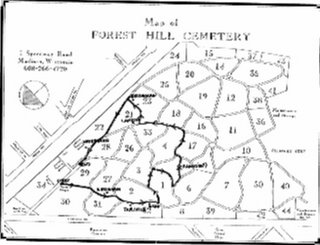
This afternoon was the ninth annual "Talking Spirits" tour at historic Forest Hill Cemetery (1859) here in Madison, and my fourth year attending. The tour is presented by The Wisconsin Veteran's Museum and it was the second consecutive year that the tour has focused on the Civil War, though with all new characters. The tour started per usual with the Catlin Chapel and old receiving vault before winding through the quiet and picturesque cemetery. You can see these buildings and read about the cemetery's history in my post of a previous tour here. I've copied a map of the cemetery and drawn out our route for ease of following along. As you can see, the tour wound through many different sections over the two-hour tour. Click on the image for a closer view.

Our first spirits met on this year's tour were William Francis Allen (Scott Rawson) and a freed Negro slave (Theola Carter). Allen was a prominent 19th century historian who established the history department at the University of Wisconsin-Madison. A Harvard graduate, Allen published hundreds of reviews, articles and lectures during his lifetime and also served as director of the Madison Free Library. From 1863 to 1865, Allen taught freed slaves in South Carolina how to read and write, in service of the Freedmen's and Western Sanitary Commission.

It was during his work here that he took note of the music of the Negro culture. Fearing that these songs would be lost forever, he began to record the songs he heard. Allen found this task to be difficult in that sounds produced by the Negro voice didn't fit normal music scales with their trills and vocal inflections, but he and his assistant worked diligently to preserve them as faithfully as they could. He also noted that when four or more people sang together, they often sang different words while remaining in perfect harmony. The result of his work was Slave Songs of the United States, a work still in publication these many years later. Theola Carter performed two of these songs in the role of a freed slave as she assisted in the telling of Allen's life, her beautiful voice and sultry weather transporting one back in time, despite the traffic on Speedway Road behind them.

I'll have more on the tour over the next few days, so be sure to check back!


Monday, October 16, 2006

Soldiers' Orphans


These two pictures are of small tombstones and accompanying obelisk in the center of Soldiers Lot, the Union graveyard at Forest Hill Cemetery.

As you can imagine, the Civil War left behind a large number of parentless children, their fathers killed during battle and their mothers either dying themselves or unable to support them. In 1866, the Harvey Hospital located near Spaight and Brearly was transformed from a soldiers' hospital to an orphanage. 683 children lived at The Soldiers' Orphans home over the course of its nine years, it's mission to care for children age 4 to 14 whose fathers had been killed during the Civil War. Eight of the children were buried here, the youngest only four years old and misidentified on the large obelisk.


Tuesday, October 10, 2006

Talking Spirits VIII: Alice Whiting Waterman, Guardian of Confederate Rest


“When in the Course of human events it becomes necessary for one people to dissolve the political bands which have connected them with another and to assume among the powers of the earth, the separate and equal station to which the Laws of Nature and of Nature's God entitle them, a decent respect to the opinions of mankind requires that they should declare the causes which impel them to the separation.”


You may recognize these words as those of Thomas Jefferson, and the opening paragraph of the Declaration of Independence. They were also the words uttered by Liz Angle as she greeted us in her role as Alice Whiting Waterman at the final stop on this year’s tour, Confederate Rest.

Confederate Rest is the northernmost Confederate graveyard and is located within Forest Hill Cemetery. 140 of the thousand plus Confederate POWs sent to Camp Randall are buried here. All but one died within weeks of their arrival, sick as they were with pneumonia or other diseases. The people of Madison turned out with bands to greet the train carrying the first load of prisoners, most of whom were part of the 1st Alabama Infantry captured at Island No. 10 in the Mississippi River. Others captured were members of the 1st Alabama, Tennessee & Mississippi Regiment. The sickest of the prisoners were ferried north via boat, the train being deemed too risky for their health, yet men who were already suffering from pneumonia or serious battle wounds were left lying on an open deck, exposed to the harsh wind and rain of a northern spring. Citizens brought food, clothing and reading material to prisoners daily, and attended the sick as best they could, but many were too far gone to recover, and were laid to rest in a “potter’s field” at Forest Hill.

Though she knew none of them, Alice felt a deep affinity for her fellow southerners, though she herself had lived in the north since the age of ten. These 140 were “her boys.” She held them in great esteem for the depth of their convictions, right or wrong, for these boys — and many of them were mere boys — believed wholeheartedly in the cause for which they fought and died, and were the embodiment of the words of Thomas Jefferson.

When Alice Whiting Waterman arrived in Madison in 1868, six years after these Confederate soldiers were laid to rest, she found their graves overgrown with weeds and fallen in disrepair. She fell to her knees to pull weeds and returned, day after day, until she had completely cleared the tiny plot, for no matter what side they were on, they deserved better than this in death. She planted hickory trees to protect their graves from the heat of summer and harsh winter winds. With the assistance of Lucius Fairchild, she raised funds to build a wooden fence around the plot, later replaced with a low stone wall, and saw that the worn wooden “headboards” were replaced with stone markers containing name, company, regiment, state and date of death. Alice diligently tended her boys for thirty years, and was laid to rest along side them, as was her final request. Following her passing in 1897, Rev. J.W. Cochran, of Christ Presbyterian Church, paid tribute to Alice Waterman as a prelude to his Sunday sermon, and can be read here.

This was the same year that Madison first celebrated Memorial Day. All businesses closed for the day, and citizens marched en masse to the cemetery for ceremonies honoring the fallen that became a tradition. It was four years later that the “misguided ‘boys in gray’” were included in a speech by Governor Cadwallader C. Washburn, who had been a Union general at Vicksburg. Following ceremonies for the Union fallen, he urged all citizens to accompany him to Confederate Rest to pay their respects to “those who sleep so far away from their once sunny and happy homes.” It was one of the earliest reconciliations between North and South, and they are still honored along side Union fallen in a sunrise ceremony each Memorial Day.


Sunday, October 08, 2006

Talking Spirits VIII: Lamson and Bridgton

I mentioned in previous entries that guides on the “Talking Spirits” tour often point out a few interesting graves not on the tour and share the story behind them. As we left General Harnden behind and continued along, our guide pointed out the monument of James Morrison, who, he said, used to keep pigs in the basement of the unfinished Capitol building, just below the assembly, and would rile them up whenever the legislature ran on too long. Intrigued by this tale, I looked him up in FOREST HILL CEMETERY, a book published by Historic Madison, Inc., according to which, Morrison was not alone: “legislators,” it says, “were fond of using long poles to stir them up to drown out the speeches of their political opponents.”

It seems that Morrison was a bit boarish himself. Contracted to finish the Capitol in 1838, the Territory later sued him for failure to account for the money—one of his many shady dealings. He was a Territorial treasurer, owned property in three states, and was partner in a mercantile firm. He committed suicide after one of his many partners brought suit against him, and five months after his death, his estate was ordered to pay restitution in the amount of $23,400 to three of his former partners—quite a large sum of money in the 1800s!


Continuing on, we next met Albert Lamson (played by Jason Valentine), a lieutenant with the 104th New York Infantry taken prisoner at a hospital near Gettysburg in July of 1863. Lamson spent ten months in Libby Prison, followed by a string of southern prisons, finally ending up at Camp Sorghum near Columbia, SC. In the autumn of 1864, he and another prisoner, Lt. E.E. Sill, affected their escape. Ordered to gather wood from the surrounding forest, they used forged paroles to slip past their captors during the day and hid in the woods until dark. They headed west through swamps, mountains and woods with dogs nipping at their trail. Subsisting on turnip root and tree bark, they used a firefly to light their compass as they followed a spur of the underground railroad.

By December they reached North Carolina, where they found aid among loyal mountaineers before recaptured by the Confederates. A Cherokee Indian was assigned to each, with orders to kill if either tried to escape, but being ever vigilant, the two once again managed to slip away. For three days they slept in the snow, eating bark and winterberries to stay alive, finally reaching the Union line at Loudon, TN—ironically about the same time Sherman liberated Camp Sorghum and set fire to Columbia. Asked later if months of enduring hardship were worth it, when rescue was so near, Lamson would only say that freedom was worth any price.

After the war, Albert Lamson went west to Wisconsin where he married Flora, daughter of James Gorham (another name familiar to Madisonians). They settled on a farm near the present-day Nakoma neighborhood, before moving to what is now Wingra Park. Pioneers in the strawberry industry, they delivered a variety of fruits and vegetables to town in a one-horse wagon.


Edward Bridgman (portrayed by Ben Conklin) was among the forty “free-staters” led by John Brown who fought off some 300 pro-slavery border ruffians at the August 30, 1856 battle of Osawatomie, Kansas Territory. He was the second to last survivor of the uprising, and served three years as a member of the 37th Massachusetts. He came to Wisconsin in the 1870s, where he served as government storekeeper on the Menominee reservation at Keshena. He and his wife were homesteaders for many years before arriving in Madison in 1901 where he was deacon at Pilgrim Church and served as chaplain of the local GAR. A popular Memorial Day speaker, his wartime experiences were immortalized through the many letters he wrote home.


Thursday, October 05, 2006

Talking Spirits VIII: Fairchild, Ward and Harnden

After taking our leave of Ebenezer Brigham, we continued up the hill a ways, where we encountered a couple of old friends, Lucius Fairchild and Andrew Ward (Cam Shimniok and Matt Kenyon), who served together in the 2nd. Wisconsin Infantry as part of the famed “Iron Brigade.” The Iron Brigade was a mostly Wisconsin company known for its reputation for its courage and tenacity in battles at Bull Run, Gainesville, Antietam (the Civil War’s bloodiest battle), and Gettysburg. The Iron Brigade suffered the most casualties of any brigade in the Civil War.

Fairchild enlisted in the army in 1861 in the Wisconsin volunteer infantry, rose through the ranks to colonel. During the first day's fighting at Gettysburg in 1863, Fairchild’s men fought fiercely against an advancing line of rebels, with 233 of his 302 men killed, wounded or reported missing, and Fairchild himself had his left elbow shattered by a bullet, and it was Fairchild’s good friend and army surgeon, Andrew Ward, who amputated his left arm. Fairchild was captured by the rebels when they took the town, but was left behind during their retreat.

Promoted to brigadier general before being mustered out of the service, Fairchild served as secretary of state of Wisconsin from 1864 to 1866. He became Wisconsin’s first three-term governor in 1866, after which he was appointed U.S. consul at Liverpool in 1871 and then consul general at Paris.


Andrew J. Ward served the 2nd Wisconsin for three years and saw to 900 wounded at The Wilderness in only a matter of days. His wife Eleanor accompanied him during those years and aided him in battle hospitals. She was said to be "cheerful and courageous" even in the harshest of conditions and loved by all who met her. Andrew Ward returned to Madison with the rank of lieutenant colonel, where he was a “wholesale and retail dealer in drugs and medicines” on King Street.


By far, the liveliest character we met on the tour was that of Henry Harnden. Descended of seafarers, Harnden was a world traveler and adventurer, sailing to the coast of Africa at age 18. By the age of 23 he had visited numerous islands in the Pacific and explored the entire west coast of South America. In 1850 he headed to California to try his hand at mining, before traveling to Wisconsin where he opened a sawmill.

Harnden joined the 1st Wisconsin Volunteer Cavalry in July 1861 and rose through the ranks to become lieutenant colonel. On March 13, 1865, he was brevetted to colonel and to brigadier general. It was about this time that the story he had to tell began. On May 6 of that year, Harnden received orders to lead a Wisconsin detachment of 150, their mission to capture Jefferson Davis. Portrayed by Tom Lodewyck, Harnden captivated the crowd in his convincing and animated telling of how he and his men tracked Jeff. Davis and, after a brief friendly-fire encounter with the 4th Michigan, finally captured the rebel at Irwinsville, GA on May 10.

Harnden mustered out of the service in July 1865 and settled in Madison where he raised Jersey cattle, owned a grocery on State Street and served as trustee to the Soldiers’ Orphans Home (more on that later). He served one term in the State Assembly (1866), as was also U.S. Assessor (1867-1873), and U.S. Collector of Internal Revenue (1873-1883). He died of pneumonia at his home in 1900, survived by his widow and four children.

Due to controversies over the capture of Jefferson Davis, Harnden wrote a short book, The Capture of Jefferson Davis (1898), which can be read online here. It truly is a fascinating and daring tale, whether or not you are a Civil War buff (which, believe it or not, I am not--though I do find it an interestingperiod in history).


Tuesday, October 03, 2006

Talking Spirits VIII: Ebenezer Brigham

First, if you missed the posts on the 2005 Talking Spirits tour, you can read them at the following links. Part 1 might especially be of interest, since it relates a great deal of cemetery history which I won't go into again this year. A few of the actors from last year's tour returned for this one, including Liz Angle, Ben Conklin and Tom Lodewyck. Also of note, one of the stops that was a last minute cancellation on last year's tour (see Part 2) was included again this year.

Part 1: Intro
Part 2: The Tour Continues
Part 3: Confederate Rest & Soldiers Lot

~~~~~~~~~~~~~~~~~~~~~~~~~~~~~~~~~~~


Map of this year's tour

One of my favorite fall events in Madison is the annual “Talking Spirits” tour through historic Forest Hill Cemetery. During the two-hour tour, visitors meet a half dozen “spirits” – some of Madison’s most prominent sons and daughters – and hear their fascinating stories. Presented by the Wisconsin Veterans Museum, the event focuses on a different conflict each year, with this year’s emphasis being on the Civil War – also known as the War Between the States. I've copied this year's map so that you can follow the path we took through the cemetery, beginning near number 34 and ending near number 29. Though we only traversed half the cemetery, it was a meandering route and not at all flat.

As is customary, the tour began at Catlin Chapel, where the director of the WVM shared information about the museum and cemetery, then introduced our guide and we were on our way.

We started towards the first stop on the tour, our guide pointing out some of the different aspects of cemetery architecture, as well as a few stones belonging to prominent Madisonians: the large silver sphere of Tenney, the tall and overly pretentious obelisk of Henry Vilas, the plot owned by the Shipman family – Stephen Shipman having been a great architect who built many of the early buildings in Madison and who literally helped rebuild Chicago after the Great Fire.

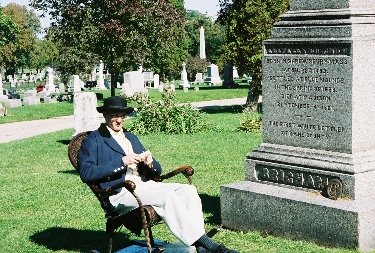
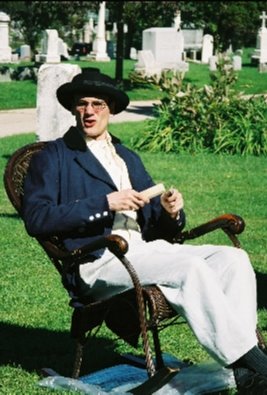
At last we came to the first spirit of this year’s tour, Ebenezer Brigham (portrayed by John Eichenlaub), who “politely” instructed us to move along up the road as he was “there first.” Silence, as he went back to his whittling, then realizing we were still there, he relented to tell us about himself. Brigham was indeed here first — or at least, he was the first permanent white settler of Dane County. He came west to St. Louis where lead was reported to be found, moved to Galena, IL, and then north to what is now Blue Mounds, where he struck the mother lode. Native Americans were also mining the hills, though their tools and methods were much more primitive, and left Brigham to his own. However, word soon spread of his bounty and miners quickly swarmed north.

Recognizing an opportunity when he saw one, Brigham opened a store for the prospectors, regularly traveling down to Galena or up to Green Bay for more supplies. It was during one of his supply trips up to Fort Winnebago that he camped on a beautiful isthmus nestled between two pristine lakes. So taken was he by the sunrise over the eastern lake the next morning that he later remarked it was at that moment he knew great city would one day be built there.

A year later he met a surveyor by the name of James Doty and told him of the narrow spit of land rising between the lakes. Doty traveled to the spot and was so taken with it that he purchased 12 acres for $1500 and named his new city after President James Madison. Both a street and a park bear the Madison name as well. Brigham served on the first Territorial Council and in 1836 pushed to make Madison the state capitol. He served until 1842, and later served a term in the assembly. He was a veteran of both the Red Bird uprising of 1827 and Black Hawk War of 1832. He died in 1861. Providing a panoramic view of the Wisconsin River Valley, Brigham County Park near Blue Mounds was named in his honor.


Friday, October 07, 2005

Talking Spirits -- Part 3: Confederate Rest & Soldiers Lot

Confederate Rest

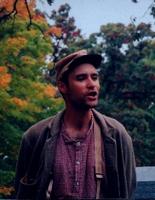
The last stop on this year's "Talking Spirits" tour was Confederate Rest where Ben Conklin portrayed a Confederate POW. He was by far the best as he did not merely play a southern soldier, he was that soldier.

Confederate Rest is the northernmost Confederate cemetery in the United States, with soldiers from Tennesee, Alabama, Arkansas and Mississippi buried here. The troops were, for the most part, from the 1st Alabama Infantry Regiment and the 55th Tennessee. They were captured in the taking of Island No. 10 in the Mississippi River, just south of Cairo, Illinois on April 7, 1862 after a 23-day siege. Most of the 5,000 prisoners were sent to St. Louis, but more than 1,000 ended up at Camp Randall in Madison.
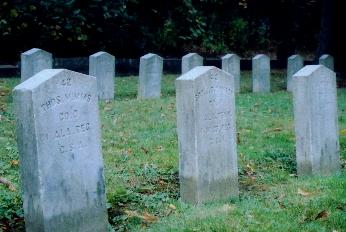
The prisoners, some as young as 17, arrived in rags, many already sick from disease and malnutrition. The citizens of Madison visited daily, bringing with them warm clothes, blankets, food and medicine. Though most of the prisoners returned to their homes in the south after the war, many stayed in Madison.


There are 140 Confederate troops buried here, all but one of whom died of disease or infection.

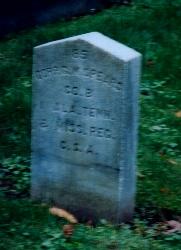
Corp. G.W. Spears was the only Confederate POW who was shot while at Camp Randall, apparently in the midst of some sort of dispute. For a list of Confederate troops buried at Forest Hill, click here and check this website for more about this tiny graveyard.


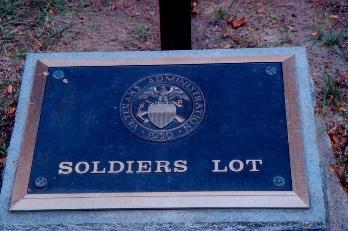
Soldiers Lot

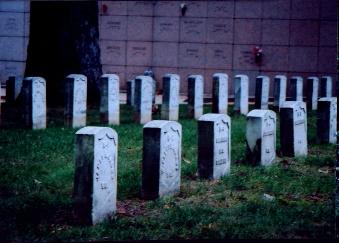
Like Confederate rest, Soldiers Lot was created during the Civil War, but it is Union troops who are buried in this small graveyard within the larger cemetery.

The two burial sections are separated by the Mausoleum, one side of which can be seen in the background of the second picture.


To read Channel 27's report on the tour mentioned earlier this week, click here.